

Lux Moundi / Wikimedia Commons / CC-BY-SA-3.0 / GFDL
Capital: Jerusalem (East)
Population: 5.5 million+ (Palestinian Central Bureau of Statistics, 2023) — 3.3 million in the West Bank and 2.2 million in Gaza.
Language: Arabic
1 – Qumran Caves (also above)
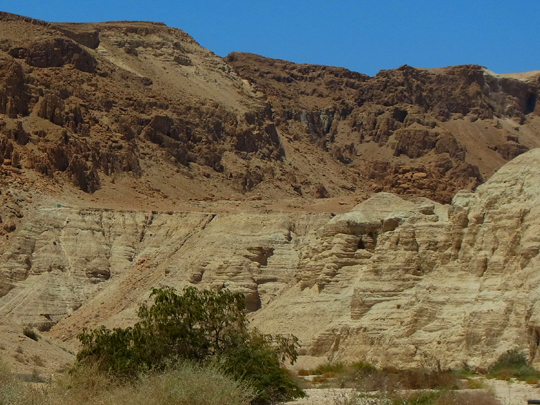
Qumran is a set of caves in a limestone cliff above the northwestern shore of the Dead Sea, with a ruined settlement on the terrace below. Between 1946 and 1956, Bedouin shepherds and then archaeologists took some nine hundred manuscripts out of eleven of those caves — the Dead Sea Scrolls. Qumran lies in Area C of the West Bank, under Israeli administration, and is run as an Israeli national park.
The caves at Qumran are holes in a cliff face; Cave 4, which gave up the largest number of fragments, is the one in every photograph. Below are the cisterns, water channels fed from the wadi, and a long room usually called the scriptorium. Who lived there is not settled — an Essene community is the standard answer, and not the only one.
Before 1947 the oldest substantially complete Hebrew Bible manuscripts known were medieval. Qumran produced copies of nearly every book of it, written between roughly the third century BC and the first AD. The manuscript record jumped back a thousand years inside a decade — and the texts proved remarkably close to what had been copied ever since.
2 – Monastery of the Temptation – Jericho
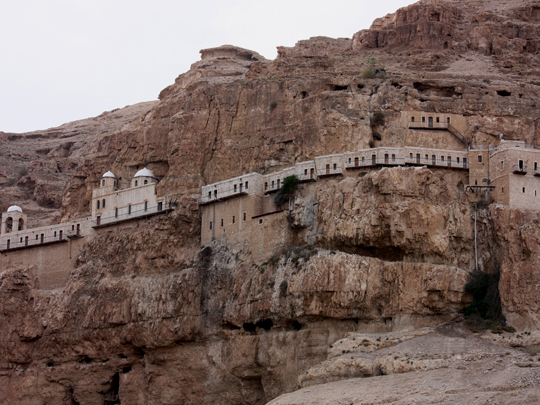
The Monastery of the Temptation is built into the face of Jabal Quruntul, the cliff above Jericho, at the place Christian tradition assigns to the forty days in the wilderness. Hermits were living in these caves by the fourth century; the monastery as it stands is Greek Orthodox and dates from 1895, raised on Byzantine foundations.
The building runs along a ledge about 350 metres up, so half of it is masonry and half is the cliff itself, with cells and chapels cut directly into the rock. A cable car has run up from the edge of Jericho since 1998 — often described as the lowest cable car in the world, since it starts from a town some 250 metres below sea level.
Tell es-Sultan, the mound at the foot of the cliff, has been occupied on and off for something like eleven thousand years, which puts it among the oldest inhabited places anywhere, and it holds a stone tower built around 8000 BC. UNESCO inscribed it in 2023.
3 – Nabi Musa
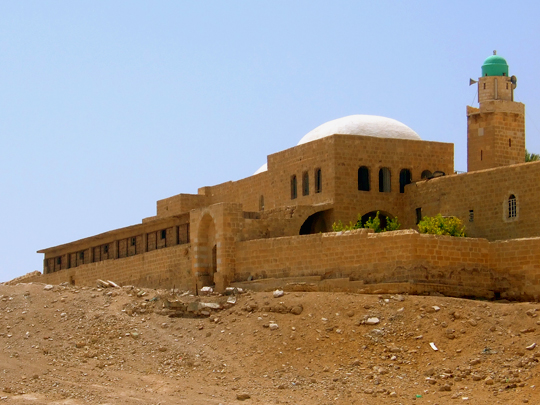
Nabi Musa is a walled complex of white domes standing on its own in the desert between Jerusalem and Jericho. Muslim tradition holds that Moses is buried here; the Hebrew Bible places his grave east of the Jordan and says that nobody knows the spot. The Mamluk sultan Baybars built the shrine in 1269, and hospices were added over the two centuries after.
Nabi Musa is as much a caravanserai as a shrine: a courtyard ringed by domed cells, with a mosque, a minaret and a cemetery outside. The Ottomans restored it around 1820 and made the Husseini family its guardians. It stands a day’s walk from Jerusalem, which is the point — it marks the end of the first stage of the old pilgrim road.
The Nabi Musa festival was a Muslim pilgrimage dated by the Christian calendar. For centuries the seven-day procession out from Jerusalem began on the Friday before Orthodox Good Friday, and it is widely held to have been arranged that way deliberately, so that Muslim crowds would be in the city at the same season as Christian pilgrims. It was suppressed after 1937 and revived in the 1990s.
4 – Mount Ebal
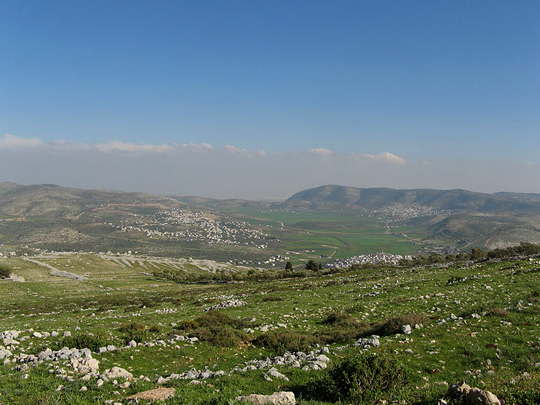
Mount Ebal rises to 940 metres directly north of Nablus and is the taller of the two mountains the city sits between. In Deuteronomy the Israelites are told to divide themselves across the pair and call out the law — the blessings from Gerizim opposite, and the curses from Ebal.
Mount Ebal is bare on its southern face and terraced lower down, and the view from the top takes in Nablus in the trench below with Gerizim standing directly across it. There are quarries on the slopes, an installation on the summit, and an Israeli settlement on the northern flank.
A structure excavated on Mount Ebal in the 1980s was identified by its archaeologist as the altar Joshua is said to have built there; and a small folded lead object recovered from the spoil was announced in 2022 as bearing the oldest Hebrew inscription ever found. Both claims are disputed by other specialists, the second sharply. The site is genuinely early. What it was is not agreed.
5 – Mount Gerizim
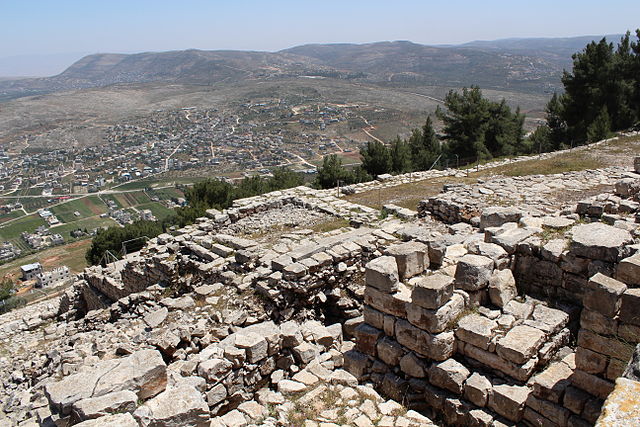
Mount Gerizim stands at 881 metres on the southern side of Nablus, facing Ebal across the valley, and it is the holiest place on earth to the Samaritans. They hold that this and not Jerusalem is the mountain God chose, that Abraham came here to sacrifice Isaac, and that the Temple belongs on this summit — where theirs stood until it was destroyed in 110 BC.
There are ruins on Mount Gerizim of that precinct and of a Byzantine church built over it, along with Kiryat Luza, the village where about half the world’s Samaritans live. The other half live in Holon, inside Israel. Between them they number only a few hundred: a community that had fallen to around a hundred and fifty a century ago and has slowly recovered since.
Every spring the Samaritans go up Mount Gerizim and sacrifice sheep for Passover, roasting them overnight in pits on the hillside. They are the only community anywhere that still performs the sacrifice as Exodus describes it, and they have been doing it on this hill, with interruptions, for well over two thousand years.
6 – Bethlehem
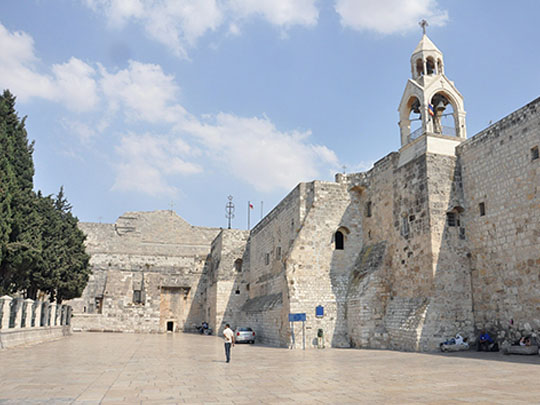

Bethlehem lies about ten kilometres south of Jerusalem, and the Church of the Nativity stands over a grotto venerated as the birthplace of Jesus since at least the second century. Constantine’s mother had the first basilica raised over it in 339; it burned in a revolt around 529 and Justinian rebuilt it — so what stands is largely sixth-century, among the oldest churches in continuous daily use anywhere on earth.
You enter the Church of the Nativity through the Door of Humility, an opening cut down to about a metre and a half so that nobody can ride in through it. Inside are Justinian’s colonnades, floor mosaics from the Constantinian church visible through trapdoors, and the grotto below with a fourteen-pointed silver star set into the floor. Three churches share the building under a Status Quo like the one at the Holy Sepulchre.
In 614 a Persian army came through and destroyed churches across the region. This one was left standing, and the explanation given — in a document written a couple of centuries afterwards — is that a mosaic on the facade showed the Magi dressed as Persians, and the soldiers would not burn a building with their own people on the front of it.
7 – Battir
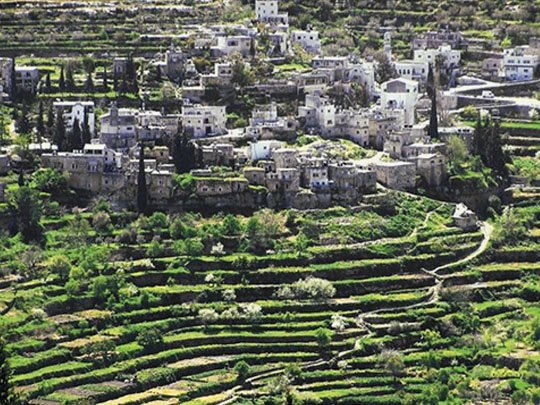

Battir is a village of terraced valleys about seven kilometres southwest of Jerusalem, and the terraces have been worked for something like four thousand years. Dry-stone walls hold the soil on slopes too steep to farm any other way, with olives and vines on the dry upper levels and irrigated vegetables below. UNESCO listed Battir in 2014 and put it on the danger list the same day.
The water at Battir comes out of springs into a Roman-era collection pool and runs downhill through open channels. The village also sits directly above the old Jaffa–Jerusalem railway, which became the armistice line in 1949 — and under the agreement signed that year its people kept the right to farm their land on the far side of the line, in exchange for guaranteeing the railway against attack.
The spring water is divided between eight extended families on a rotation. Each family takes the whole flow for its allotted turn and then hands it on, and the cycle runs round and starts again — arithmetic and trust, distributing the same spring for centuries, and still how Battir is watered. UNESCO cited the system specifically in the inscription.
8 – Hebron
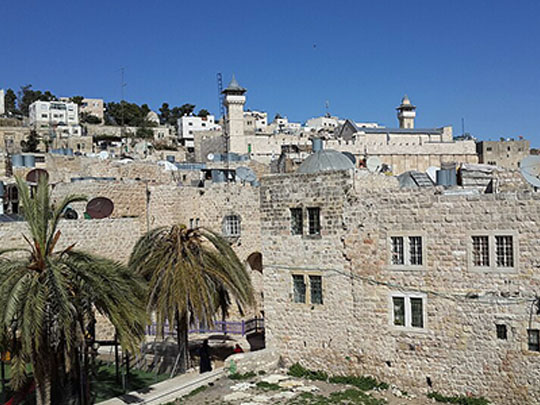

Hebron is the largest city in the West Bank, and at the centre of it stands the building Muslims call the Ibrahimi Mosque and Jews the Cave of the Patriarchs — the traditional burial place of Abraham and Sarah, Isaac and Rebecca, Jacob and Leah, and so sacred to all three Abrahamic religions. UNESCO inscribed the old town of Hebron in 2017 and placed it on the danger list at the same time.
The old city has a covered souq, glass and ceramic workshops that have operated for centuries, and the last kuffiyeh factory in Palestine. Since 1994, when twenty-nine worshippers were shot dead inside it, the building over the tomb has been partitioned between a mosque and a synagogue with separate entrances; each community has the whole of it for ten days a year.
The enclosure itself is Herodian — first century BC, built by the same king and the same masons as the Temple Mount, with the same drafted stones and pilastered walls twelve metres high. It is the only building of Herod’s that survives essentially intact and still roofed. There is nothing in Jerusalem as complete.
9 – Gaza
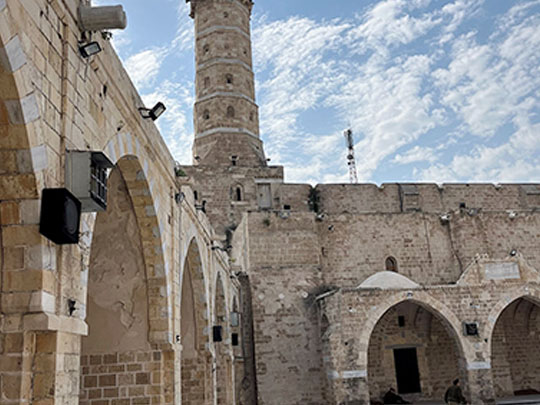

Gaza is among the oldest continuously inhabited cities in the world. It sits on the coastal road between Egypt and the Levant, which made it a port and a caravan town for four thousand years and put it in the path of every army that used that road — Egyptian, Assyrian, Persian, Greek, Roman, Arab, Crusader, Ottoman and British. Before October 2023 the Strip held about 2.2 million people in 365 square kilometres.
What follows describes what stood there before that date. The Great Omari Mosque, Gaza’s oldest and largest, on ground that had carried a Philistine temple, then a fifth-century church, then a mosque from the seventh century on. The church of Saint Porphyrius, fifth-century, among the oldest still in use anywhere. Qasr al-Basha, a Mamluk palace turned museum. Anthedon, the first known harbour, from around 800 BC. A fourteenth-century bathhouse still working. UNESCO has since verified damage to more than a hundred cultural sites across the Strip.
In July 2024 UNESCO inscribed the monastery of Saint Hilarion at Tell Umm el-‘Amr — fourth-century, among the earliest monastic sites in the Middle East — under its emergency procedure, and placed it on the List of World Heritage in Danger the same day. That is the fourth time it has done exactly that for a Palestinian site, after Bethlehem, Battir and Hebron.