
Wikimedia Commons / CC-BY-SA-3.0 / GFDL
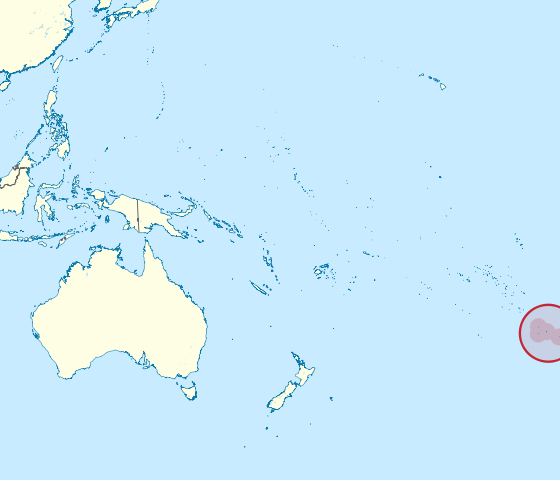
Capital: Adamstown
Population: 35 approx.
Pitcairn is the smallest territory in the world by permanent resident population.
Language: English/Pitcairnese
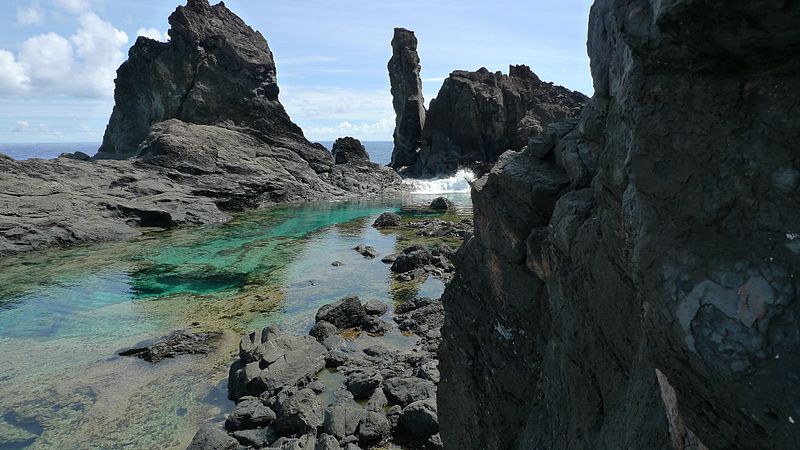
1 – St. Pauls Pool (above)
On the eastern side of Pitcairn, below St Paul’s Point, the sea surges over old lava flows and fills a deep natural basin in the rock — the finest thing on an island that is essentially one steep volcanic lump, four and a half square kilometres of it, with no harbour and no easy landing anywhere.
The pool is clear enough to snorkel when the swell allows, and the walk out there passes the turn-off for Down Rope, a rope-assisted scramble to the foot of a 200-metre cliff and the island’s only patch of sand.
Polynesians lived on Pitcairn for centuries and were gone before any European saw the place: when the mutineers landed in 1790 they found stone platforms, carved figures, cutting tools and food plants left behind. The panel of petroglyphs cut into the rock at Down Rope is still there — human figures, animals and a canoe, carved by people whose departure has never been explained.
2 – Ducie Island
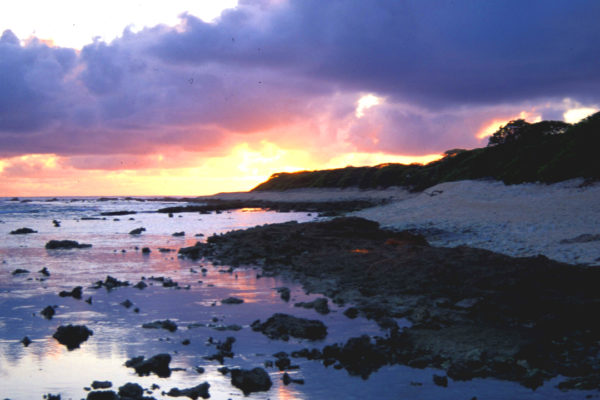
The most remote of the four Pitcairn islands, a small coral atoll of four islets around a lagoon some 350 miles east of Pitcairn itself, uninhabited, ringed by reef and almost never visited.
There is nothing built here at all, but the birds are the point: more than nine-tenths of the entire world population of Murphy’s petrel nests on Ducie, along with tropicbirds, fairy terns, frigatebirds and boobies.
Ducie was charted and named in March 1791 by Captain Edward Edwards of HMS Pandora, who was at that moment sailing the Pacific hunting the Bounty mutineers — he made a point of inspecting every island he passed, and had he held his course west along the same parallel he would almost certainly have found them; instead he turned north, and Pitcairn stayed hidden for another seventeen years.
3 – Adamstown

The only settlement in the territory sits on a shelf above Bounty Bay and is named after John Adams, the last mutineer left alive. The community was founded on 15 January 1790 when Fletcher Christian brought the Bounty in with eight mutineers and around eighteen Tahitian men and women, several of whom had effectively been abducted. The ship was burned eight days later so nobody could leave.
Christian chose Pitcairn precisely because it was lost: Carteret had charted it in 1767 without an accurate chronometer and put it about three degrees of longitude out, nearly 200 miles from where it actually sits — Cook looked for it in 1773 and failed, and no ship found the mutineers until an American sealer stumbled on them in 1808.
The square holds the church, the museum and the Bounty‘s anchor, John Adams’ grave is a short walk away, and above the settlement is Christian’s Cave, the overhang where he is said to have watched for sails. The Bounty‘s chronometer, handed over by John Adams in 1808, went through Spanish and Chilean hands before ending up in Greenwich, where it still is.
4 – Henderson Island

A raised coral island 120 miles northeast of Pitcairn, ringed by undercut limestone cliffs and covered in forest, Henderson accounts for most of the territory’s land area and was made a World Heritage site in 1988 as one of the last near-pristine islands of its kind anywhere.
Nobody lives there and landing is difficult; all four of its land birds live nowhere else, including a flightless crake, though the beaches now carry one of the highest densities of plastic debris ever recorded, drifted in from thousands of miles away on the South Pacific gyre.
In December 1820 the survivors of the Nantucket whaleship Essex, sunk by a sperm whale, made landfall here in three open boats, stripped the island of food within a week and sailed on — three men chose to stay and were rescued four months later, and the story of the Essex is what gave Herman Melville the ending of Moby-Dick.