
Wikimedia Commons / CC-BY-SA-3.0 / GFDL
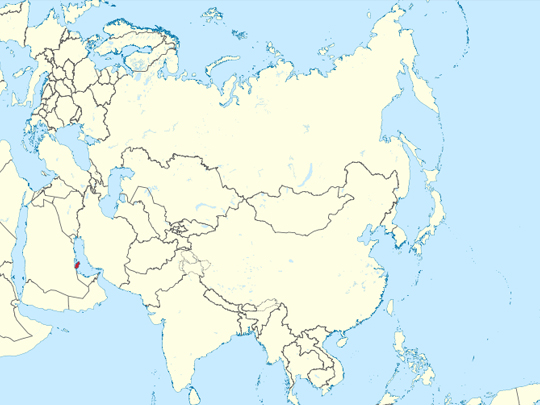
Capital: Doha
Population: 3.1 million+
Language: Arabic, English, Malayalam.
1 – The Pearl (also above)
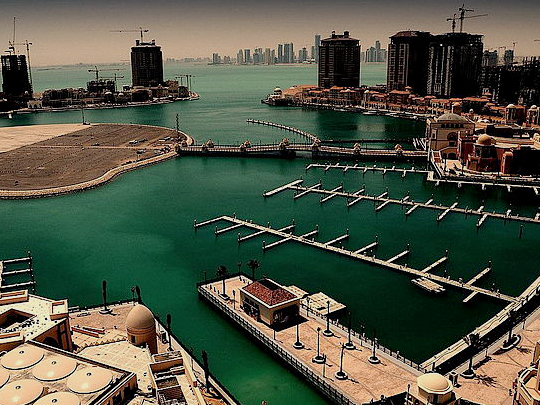
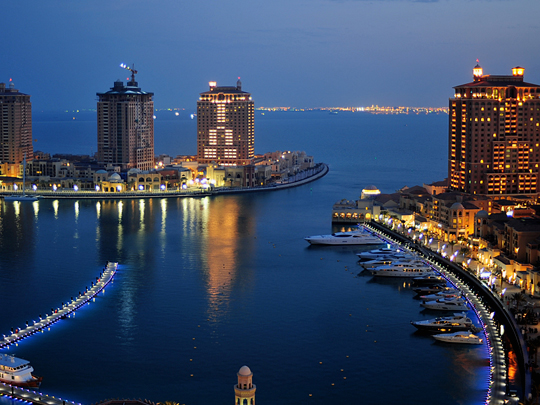
The Pearl is an artificial island of about four square kilometres dredged into being off Doha’s West Bay from 2004, over water where Qatari crews once dived for the pearls the country lived on; the first residents moved in during 2012 and something like fifty thousand people live there now.
The Pearl is laid out as themed districts — Porto Arabia, a marina ringed by some thirty towers; Qanat Quartier, a Venetian pastiche of canals, coloured houses and fifteen bridges including a copy of the Rialto; Viva Bahriya and Medina Centrale — with a yacht harbour, a beach and a long parade of restaurants along the water.
The Pearl was the first ground in Qatar foreigners were permitted to buy outright, which is the real reason it exists, and its name is an epitaph: the pearl trade it commemorates was destroyed in the 1920s and 30s by Japanese cultured pearls selling at a tenth of the price, and Doha’s population fell from around 27,000 to 16,000 as people left to find work.
2 – Villaggio Mall
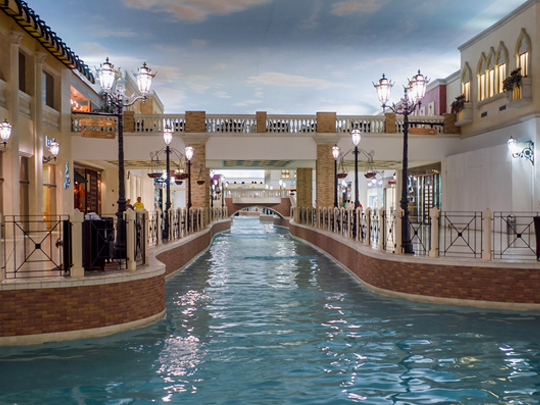
Villaggio Mall opened in 2006 in Doha’s Aspire Zone and is a Qatari answer to a climate problem: for months of the year it is too hot to walk anywhere outdoors, so the mall does the work a street does elsewhere, with 220 shops, an ice rink, a theme park and a cinema under one roof.
The conceit at Villaggio is Venice — a 150-metre indoor canal with gondolas and gondoliers, stucco facades along the concourse, and a painted sky ceiling fixed permanently at early evening — carried off with no embarrassment whatsoever, which is most of its charm.
On 28 May 2012 a fire that started in a shop on the upper floor filled Villaggio with smoke and killed nineteen people, thirteen of them children in a nursery inside the mall; the official investigation found that the nursery had no emergency exit and had never been licensed as one, witnesses described a fire alarm that sounded like a doorbell, and firefighters took two hours to reach the children.
3 – Museum of Islamic Art
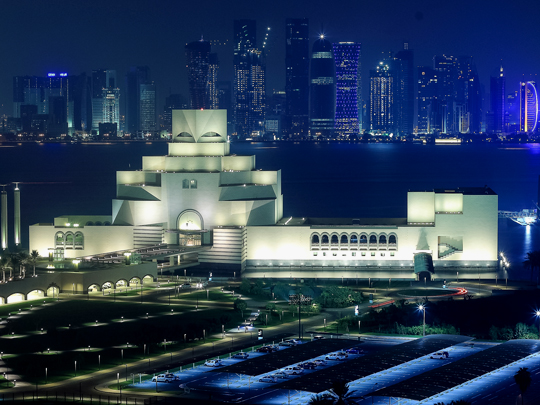
The Museum of Islamic Art stands on its own artificial island about sixty metres off the Doha Corniche, and it is there because I. M. Pei, coaxed out of retirement at ninety-one to design it, rejected every site he was offered and asked for an island instead, so that nothing could ever be built up against his building.
Pei spent six months travelling the Muslim world before drawing anything and took his form from the ablution fountain of the ninth-century Ibn Tulun mosque in Cairo, which at the Museum of Islamic Art becomes a stack of pale stone cubes rotating as they rise, a five-storey atrium beneath an oculus, and a north wall of glass framing the West Bay towers across the water.
Inside is one of the most complete collections of Islamic art anywhere — metalwork, ceramics, textiles, glass, jewellery and manuscripts spanning Spain to India across thirteen centuries — including a leaf of the Blue Qur’an, gold script on parchment dyed deep indigo, made more than a thousand years ago.
4 – Souq Waqif
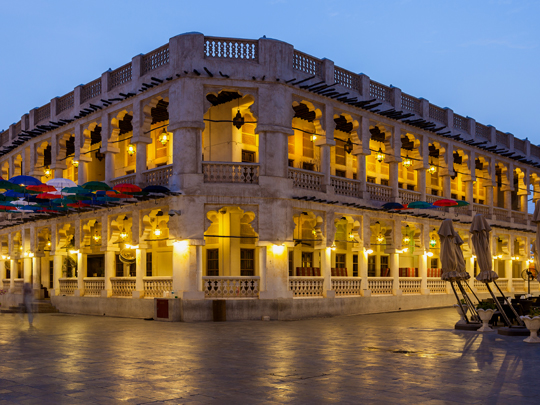
Souq Waqif — “the standing market” — occupies the dry bed of Wadi Musheireb in central Doha, on the ground where Bedouin came in from the desert to trade livestock and goods with the town, back when the shoreline was close enough that boats were part of the same commerce.
Souq Waqif is a warren of narrow alleys selling spices, textiles, oud, carpets and kitchenware, with shisha cafés and restaurants around the open edges, the Amiri Guard’s horses stabled at one side, and a falcon souq where hooded birds sit in rows on perches and the stalls alongside sell GPS trackers to fit to them.
Most of what you walk through at Souq Waqif is younger than it looks: fire destroyed much of the market in 2003, and the restoration that followed between 2006 and 2008 demolished everything put up after the 1950s and rebuilt in mud render, timber and bamboo — a reconstruction, honestly done, of a place that had already been half-modernised away.
5 – Doha Corniche
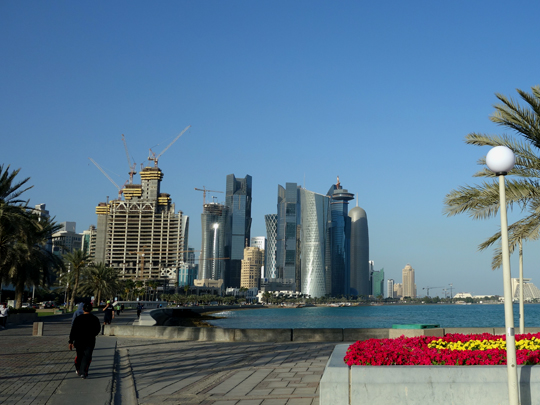
The Doha Corniche is a seven-kilometre promenade curving right around Doha Bay, and almost none of the ground beneath it is natural: the bay was dredged and filled from the late 1960s onward, the first city plan alone reclaiming some 630 hectares.
Walking the Doha Corniche takes you past wooden dhows moored along the water, the Museum of Islamic Art on its island at one end and the West Bay towers at the other, the Amiri Diwan set back behind, and the Sheraton — a brown concrete pyramid opened in 1982 on a made island of its own, which was the tallest thing here at the time and is now dwarfed by everything around it.
The Doha Corniche is the clearest statement of what Qatar has done with its money: Souq Waqif once stood on the shore, and the reclamation pushed the sea back something in the order of 335 metres, so the old market now sits inland of a coastline that did not exist when it was built.
6 – Al Zubarah
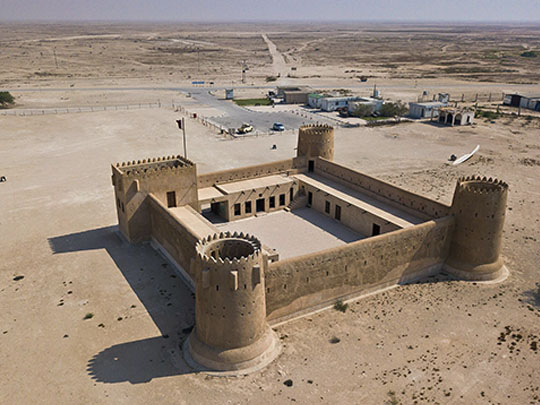

Al Zubarah is a ruined pearling and trading town on Qatar’s northwestern coast, a hundred kilometres from Doha, founded in the 1760s by Bani Utbah merchants down from Kuwait; at its height it held six to nine thousand people inside a walled sixty hectares and traded pearls and dates as far as India, Oman and Iraq.
What you arrive at is Al Zubarah Fort — a square mud-brick block with corner towers, built in 1938 and now the visitor centre — but the World Heritage Site inscribed in 2013 is the town beyond it: excavated streets, courtyard houses, a harbour and a wall, most of it still under sand, which is exactly what preserved it.
The ruler of Muscat destroyed Al Zubarah in 1811 and it emptied over the century after, but the Al Khalifa, who rule Bahrain today, started out here before crossing the water in 1783 — and Bahrain’s claim on that basis kept an abandoned ruin in litigation at the International Court of Justice for ten years, until the court awarded Al Zubarah to Qatar in 2001.