
Wikimedia Commons / CC-BY-SA-3.0 / GFDL
Capital: Moscow
Population: 145 million+
Language: Russian (more than thirty other languages hold official status).

1 – Red Square – Moscow (also above)
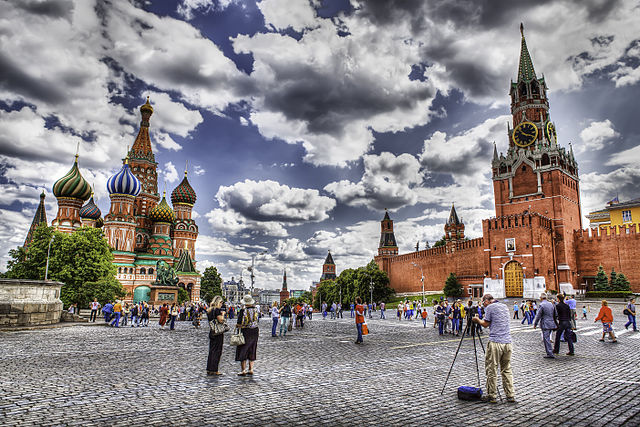
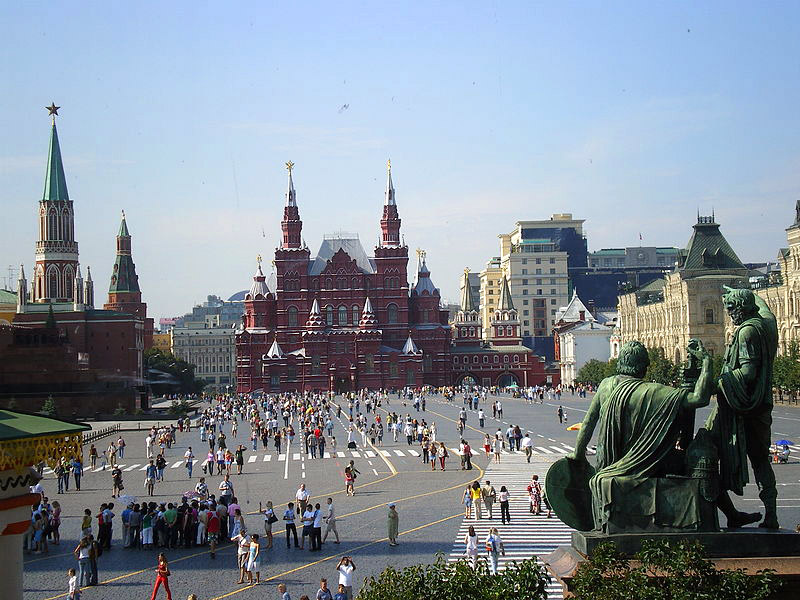
Red Square is the open ground outside the eastern wall of the Moscow Kremlin, roughly 330 metres by 70, cleared as a market in the fifteenth century and known for a while as the Burnt Place after the fires that repeatedly went through it; it has been the Kremlin’s ceremonial forecourt ever since, and UNESCO listed the two together in 1990.
St Basil’s stands at the southern end of Red Square — nine chapels bundled into one building, raised by Ivan the Terrible between 1555 and 1561 for the capture of Kazan — with the GUM arcade of 1893 down one long side, the State Historical Museum closing the north end, and the Kremlin wall running the length of the other.
Red Square is not named for the Bolsheviks or for brick: krasnaya in older Russian meant beautiful as well as red, and the name predates both — just as the story that Ivan blinded St Basil’s architect is false, since Postnik went on to work at the Kazan Kremlin afterwards and his grandson held court office in 1633.
2 – Great Kremlin Palace
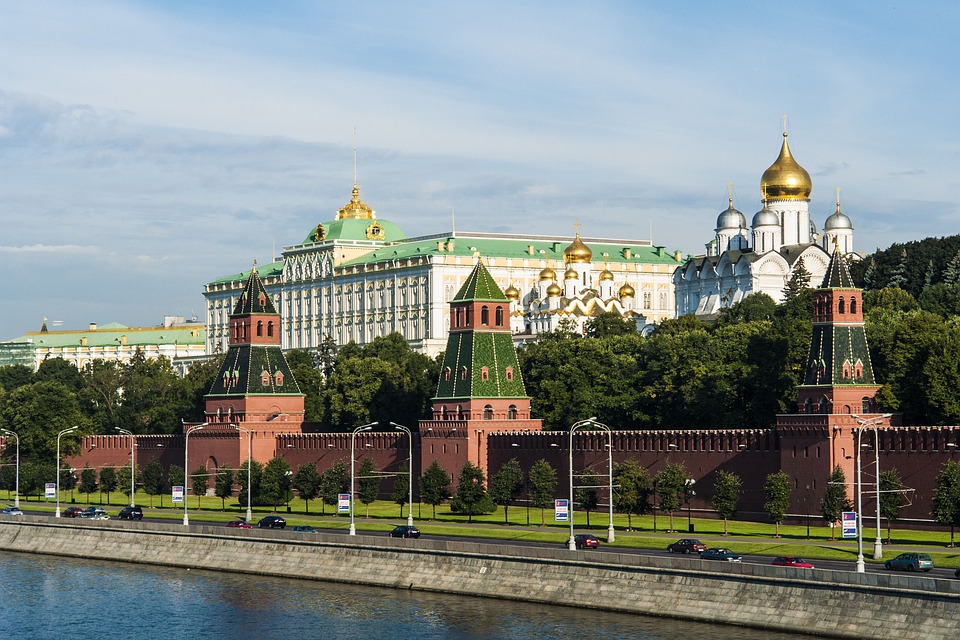
The Great Kremlin Palace is the long yellow-and-white block above the Moscow River inside the Kremlin walls, built between 1837 and 1849 by a team under Konstantin Thon as Nicholas I’s official Moscow residence — the tsar’s house in the old capital, three centuries after the court had moved to St Petersburg and back again.
Behind the facade are the five Order halls, named for the imperial orders of chivalry, of which St George’s is the largest at sixty-one metres, its walls tabulating the regiments and the names of more than ten thousand officers decorated with the order.
You cannot go in: the Great Kremlin Palace is the official Moscow residence of the President, and the Kremlin Museums list visits as suspended — what a ticket actually buys you inside the walls is Cathedral Square and its churches, the Tsar Bell and Cannon, and the Armoury, which is part of the same palace complex, so you get into the ensemble without ever seeing the state rooms.
3 – Grand Peterhof Palace
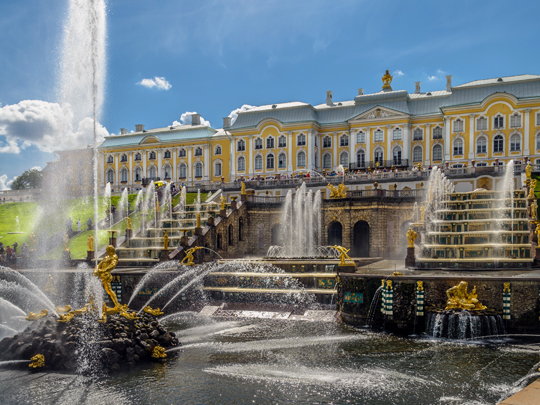
Peterhof sits on the Gulf of Finland about thirty kilometres west of St Petersburg, begun by Peter the Great in 1714 and enlarged by Rastrelli in the 1740s and 50s into a three-hundred-metre facade above a terrace — a deliberate answer to Versailles, built by a tsar who had visited the French court and come home with ideas.
The Grand Cascade drops from the palace to the sea canal in a stack of gilded figures, more than sixty fountains and some two hundred and fifty sculptures, with Samson tearing open the lion’s jaws at the centre and throwing water twenty metres up.
Not one pump has ever been used at Peterhof: water runs downhill from springs in the Ropsha Heights some twenty-two kilometres inland, through ninety-six kilometres of canals into sixteen storage ponds and then to the nozzles under nothing but gravity, at eleven hundred litres a second — and a crew of ten still opens the whole system by hand every morning, exactly as it was designed to work in 1721.
4 – Church of the Savior on Blood – St. Petersburg
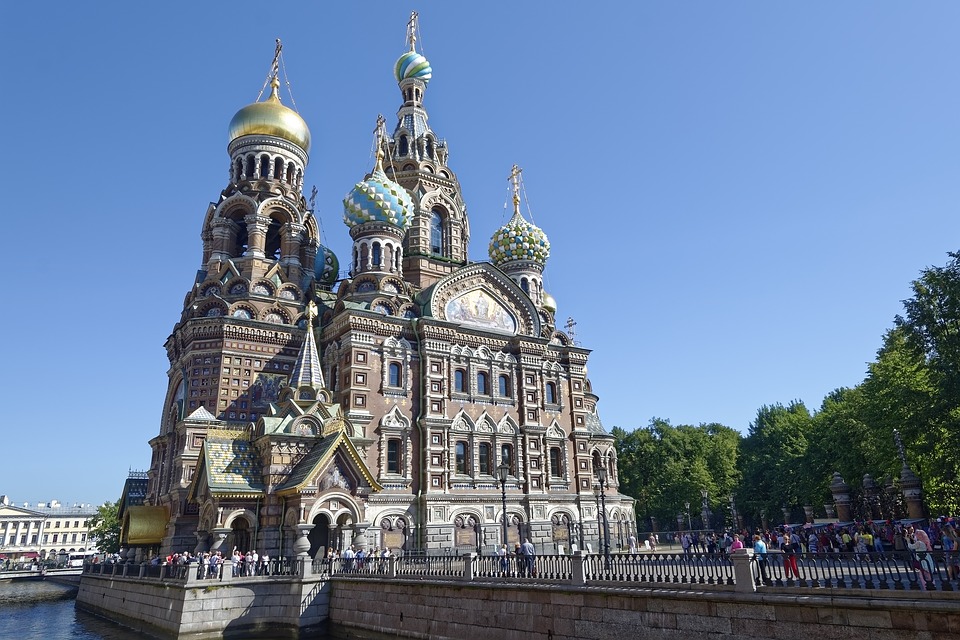
The Church of the Saviour on Spilled Blood stands on the Griboedov Canal embankment in St Petersburg, on the spot where Alexander II was fatally wounded on 13 March 1881 — the first bomb wrecked his carriage and killed a Cossack and a delivery boy without touching him, and he got out to look at the damage, which is when the second was thrown at his feet.
Alexander III had it built over the site between 1883 and 1907 in deliberate old-Russian style, all onion domes and patterned brick in a city of neoclassical stone, with some seven thousand square metres of mosaic over every interior surface and a jasper canopy above the original cobblestones and canal railing, preserved where they were.
Leningraders called it Spas na Kartoshke — Saviour on Potatoes — after the Soviet state closed it and stored vegetables in it; a German shell sat lodged in the vaulting from the siege until sappers took it out in 1961, and it reopened as a museum in 1997 after a restoration three years longer than the original build.
5 – Bolshoi Theare – Moscow
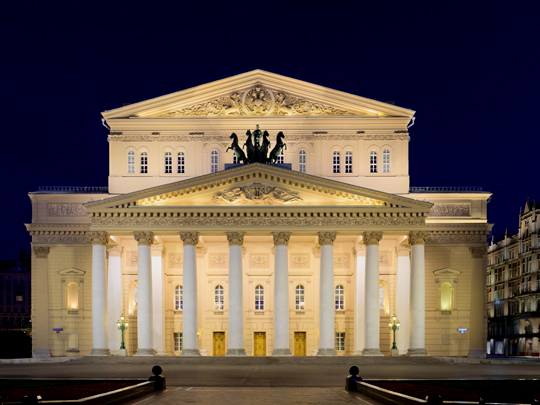
The Bolshoi company dates from 1776, when Catherine II granted Prince Pyotr Urusov the right to stage performances in Moscow, but the building has burned repeatedly — the theatre of 1825 went up in the fire of 1853, and what stands on Theatre Square today is Alberto Cavos’s rebuilding of 1856.
The Bolshoi’s portico carries eight columns and a bronze quadriga of Apollo above them, and behind it the red-and-gold auditorium was stripped back to bare structure in a restoration that began in 2005, was meant to take three years, took six, and cost an officially admitted 21 billion roubles against a budget less than half that.
Nobody can prove who sculpted the quadriga — the attribution to Pyotr Klodt is traditional and undocumented — which is a strange gap for the most reproduced sculpture in Moscow, since the Bolshoi and its horses were on the hundred-rouble note for twenty-five years until the 2022 redesign dropped them for the Spasskaya Tower.
6 – Catherine Palace – Tsarskoye Selo
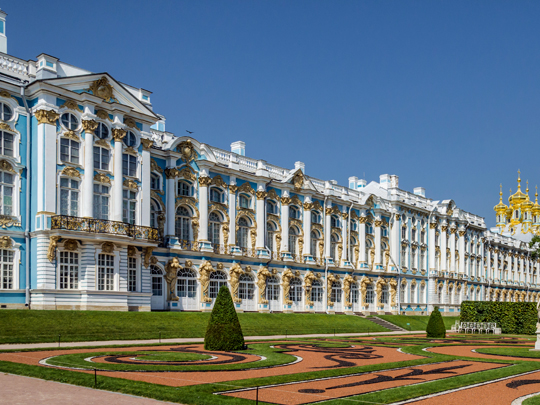
The Catherine Palace stands at Tsarskoye Selo, about twenty-five kilometres south of St Petersburg, and is Rastrelli’s 1750s rebuilding for Empress Elizabeth of a modest house her mother had put up — three hundred metres of azure and white with so much gilding on it that Catherine the Great later had much of it stripped back as vulgar.
Inside the Catherine Palace are the Great Hall under its painted ceiling, Cameron’s cool neoclassical rooms for Catherine II, and the Amber Room — six tonnes of worked Baltic amber, a gift from the King of Prussia to Peter the Great in 1716, enlarged by Rastrelli to fit a far bigger wall.
German troops stripped the Amber Room in thirty-six hours in 1941 and shipped it to Königsberg in twenty-seven crates, and it has never been seen since: treasure hunters still look for it, but the Soviet investigator sent in 1945 found burnt remains in the castle cellar and concluded it had gone up with the building — a verdict he was denounced for and which historians now broadly accept.
7 – Kazan Cathedral

Kazan Cathedral stands on Nevsky Prospekt in the middle of St Petersburg, built between 1801 and 1811 to house the icon of Our Lady of Kazan, and designed by Andrey Voronikhin — who had been born a serf on the Stroganov estates and was not freed until he was twenty-five, which makes him an improbable author of the imperial capital’s principal church.
Orthodox rule puts the altar at the east, so Kazan Cathedral’s front door faces away from the street and Voronikhin solved it by throwing a colonnade of ninety-six columns across the northern flank, turning a side wall into a ceremonial face; a matching colonnade on the south side was drawn and never built, so the building is permanently half-finished.
Field Marshal Kutuzov prayed here before leaving to take command against Napoleon and was buried here in 1813, with captured French standards and the keys of surrendered cities hung around his grave — and the Soviet state, with a certain logic, turned the whole building into the Museum of the History of Religion and Atheism.
8 – Winter Palace & Alexander Column – St. Petersburg
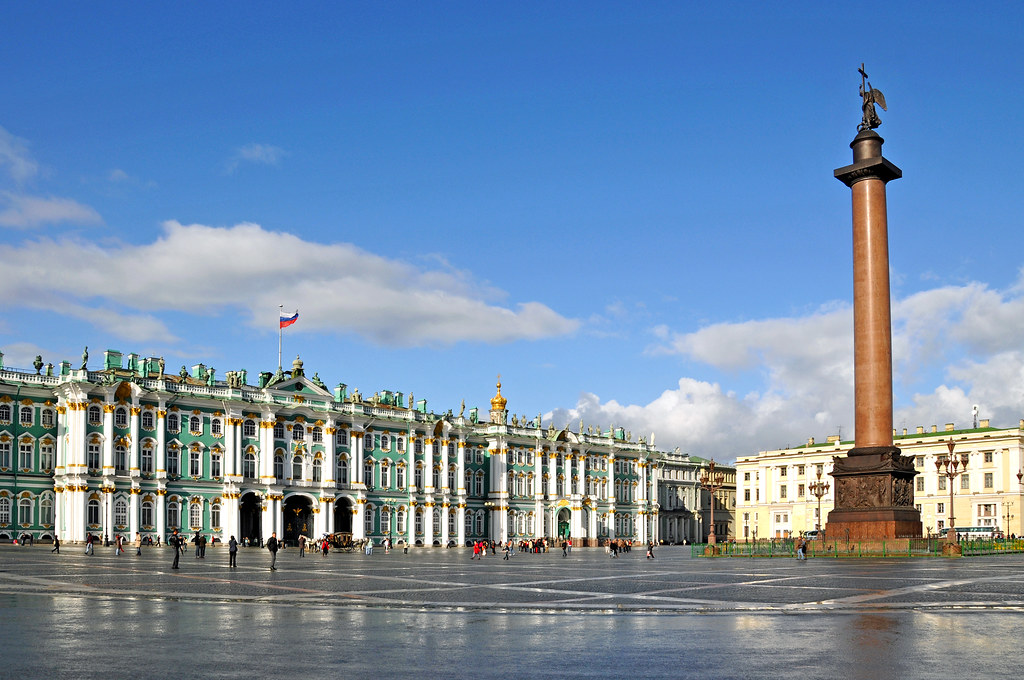
The Winter Palace is Rastrelli’s fourth palace on the site, built for Empress Elizabeth between 1754 and 1762, some fifteen hundred rooms behind a facade two hundred and fifteen metres long, and the principal residence of the Russian emperors until 1917; it now holds most of the Hermitage.
Palace Square in front of it is closed by the Alexander Column, put up by Auguste de Montferrand for Nicholas I in memory of Alexander I and the defeat of Napoleon — a single granite shaft of around six hundred tonnes, raised by three thousand men in under two hours in 1832 and unveiled in 1834, which stands by its own weight with nothing fixing it to the base.
The storming of the Winter Palace in October 1917 was nothing like the version everyone pictures: the defenders surrendered, the building came out of it with a chipped cornice and a broken window, and the crowds people remember are photographs of a mass theatrical reenactment staged on this square in 1920, routinely passed off since as documentary images of the event.
9 – Bronze Horseman – Saint Petersburg
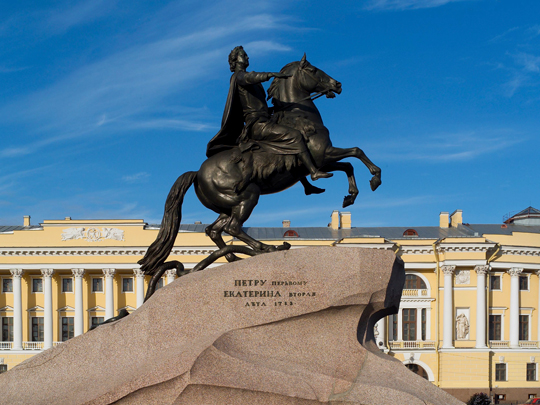
The Bronze Horseman stands on Senate Square in St Petersburg, a few hundred metres round the corner from the Winter Palace, and is Catherine the Great’s monument to Peter I — unveiled in 1782 by Étienne Maurice Falconet, who had fallen out with the empress, left Russia four years earlier and never saw it standing.
The inscription on the Bronze Horseman reads Petro Primo Catharina Secunda — to Peter the First from Catherine the Second — which is a German-born usurper writing herself into the line of succession in Latin, and the serpent under the horse’s hooves is both the defeated enemies of reform and the structural third leg holding a rearing horse upright.
The pedestal is the Thunder Stone, a granite boulder found in a marsh at Lakhta and dragged six kilometres to the water by four hundred men working hand capstans, over bronze balls rolling in grooved metal rails, through the winter of 1769, with masons carving it as it moved — still the record holder for the largest stone ever moved by human muscle alone.
10 – Lenin’s Mausoleum
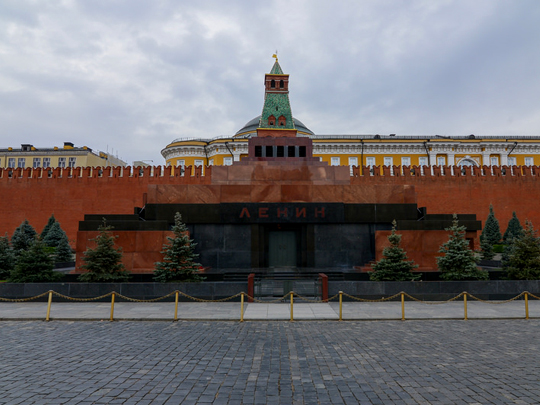
Lenin’s Mausoleum stands against the Kremlin wall on Red Square, the centre of a necropolis that also holds Stalin, Brezhnev, Andropov, Chernenko and Gagarin’s ashes; Lenin died in January 1924 and the Politburo decided to preserve him against the objections of his widow, Nadezhda Krupskaya, who wanted no part of it.
The building you see is the third in six years — two wooden versions came first — finished in 1930 by Alexey Shchusev in marble, porphyry, granite and labradorite, and admission is free, mornings only, with a queue, a bag check and no photographs inside.
What lies in Lenin’s Mausoleum is less a preserved corpse than a maintained object: the organs and brain were removed, so were the arteries and veins, the eyes are synthetic, and every eighteen months or so the body goes into chemical baths for weeks at a time — a dedicated laboratory has done nothing else since 1924, and its techniques were later exported to Hanoi and Pyongyang.
11 – Mamayev Kurgan – Volgograd
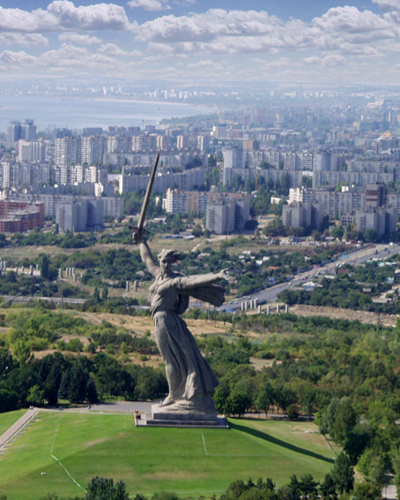
Mamayev Kurgan is the hill above Volgograd that appears on wartime maps as Height 102.0, and whoever held it could range artillery over the whole city and the Volga crossings behind it, which is why it changed hands again and again through the Battle of Stalingrad; more than thirty-four thousand soldiers are buried in it.
The memorial complex climbs the hill by two hundred steps, one for each day of the battle, past ruined-wall reliefs and the Hall of Military Glory — a round chamber where a five-metre marble hand rises from the floor holding the eternal flame, with seven thousand names on the walls and an honour guard changed every hour.
The Motherland Calls at the summit is eighty-five metres from base to sword tip and was the tallest sculpture in the world when it was finished in 1967, and it is anchored to nothing: eight thousand tonnes of concrete standing on its own weight, held upright by a hundred and seventeen steel cables inside a shell thirty centimetres thick, leaning slowly toward the river.
12 – Lake Baikal
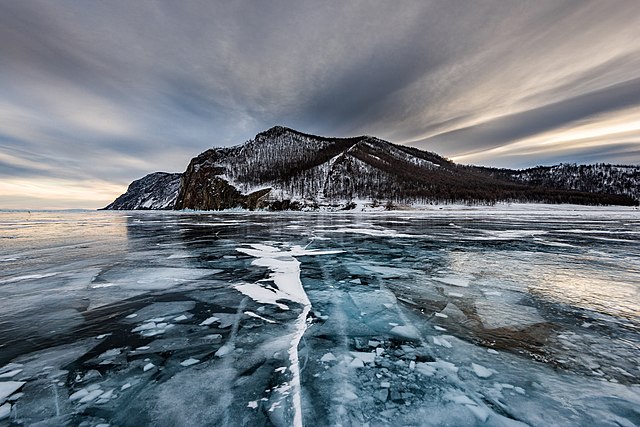
Lake Baikal lies in southern Siberia along an active continental rift, which is why it is 1,642 metres deep — the deepest lake on earth — and around twenty-five million years old, making it the oldest as well; UNESCO listed it in 1996, and the rift is still pulling it wider by roughly two centimetres a year.
Baikal holds about a fifth of the world’s unfrozen surface fresh water, more than all five North American Great Lakes together, and it freezes solid from January into May under half a metre to a metre and a half of ice, clear enough in places to see down through it.
The lake has a seal: the nerpa, Pusa sibirica, the only seal species anywhere that lives exclusively in fresh water, some eighty to a hundred thousand of them three thousand kilometres from the nearest ocean — nobody is certain how they got there, whether up the Arctic river systems or through ice-age lakes that no longer exist.
13 – Valley of Geysers – Kamchatka
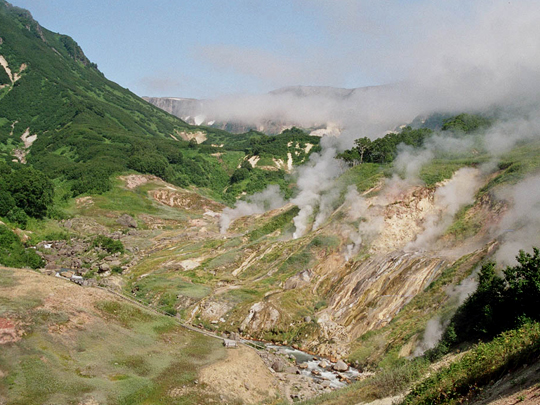
The Valley of Geysers is a six-kilometre river gorge in the Kronotsky Reserve on the Kamchatka Peninsula, unknown to science until the geologist Tatyana Ustinova walked into it in April 1941, and it is generally reckoned the second largest geyser field in the world after Yellowstone.
Around ninety geysers, along with hot springs, mud pots and steam vents, line the walls of the Valley of Geysers above the Geysernaya River; there are no roads, the reserve is a strict one, and visitors arrive by helicopter, are capped in number and stay on the boardwalks.
On 3 June 2007 a landslide buried roughly two-thirds of the Valley of Geysers and dammed the river, drowning many of the vents under a new lake — including the first geyser Ustinova ever named — and then on 3 January 2014 a mudflow tore the dam out again, drained the lake and brought them back, several now erupting more often than they did before.
14 – Mount Elbrus
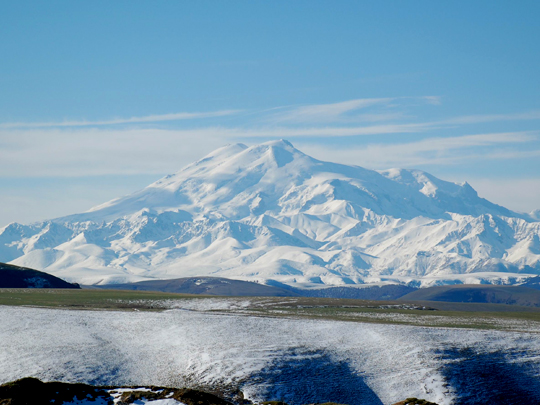
Mount Elbrus rises to 5,642 metres in the Caucasus of southern Russia and is a dormant volcano, not an extinct one — it last erupted around AD 50 and still vents fumaroles on its eastern flank — with twin summits, the eastern one first climbed in 1829 by a local guide with a Russian imperial expedition.
Mount Elbrus is Europe’s highest mountain under the boundary convention almost everyone now uses, which runs the continental divide along the crest of the Greater Caucasus and leaves the mountain about eleven kilometres inside Europe; an older line drawn further north would put the whole range in Asia and hand the title back to Mont Blanc.
A cable car lifts you to 3,847 metres and the summit needs no technical climbing at all, which is exactly the problem: Elbrus kills perhaps fifteen to thirty people a year, more than any other of the Seven Summits, mostly unacclimatised walkers caught by weather on a featureless snow dome with nothing to navigate by.
15 – Dormition Cathedral – Vladimir
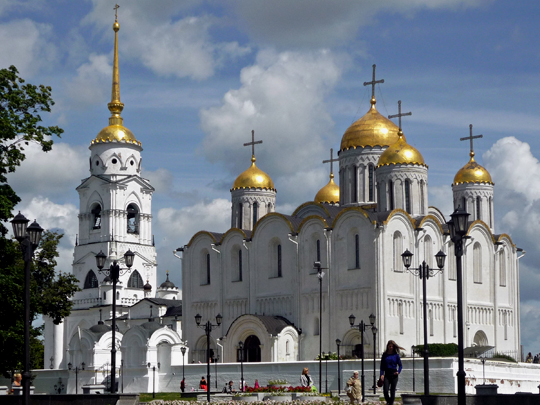
The Dormition Cathedral in Vladimir was raised by Andrei Bogolyubsky between 1158 and 1160, rebuilt larger after a fire in 1185, and was the tallest and most important church in Rus for centuries — the place where the grand princes were enthroned, deliberately built higher than St Sophia in Kyiv to make the point that power had moved north.
The Dormition Cathedral is white limestone under five gilded domes above the Klyazma river, carved on the outside and containing fragments of the frescoes Andrei Rublev and Daniil Chorny painted in 1408 — some three hundred square metres of them, chiefly a great Last Judgment on the west wall.
Those are the only frescoes anywhere that can be securely attributed to Rublev, and the building’s influence outlasted its city: when Ivan III wanted a cathedral for the Moscow Kremlin, he hired the Bolognese engineer Aristotele Fioravanti and sent him north to Vladimir to study this one before he began.
16 – Novodevichy Convent – Moscow
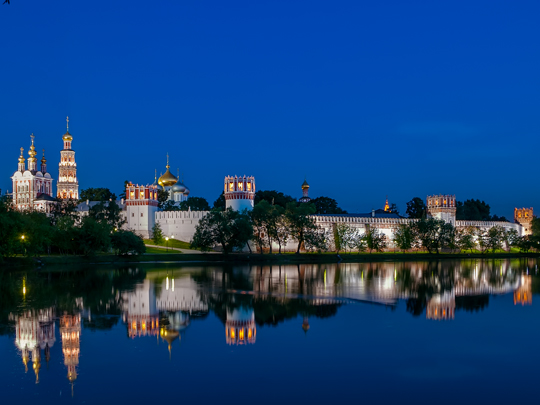
Novodevichy Convent was founded in 1524 by Vasili III to mark the taking of Smolensk, and built as much as a fortress as a monastery — one of a ring of walled convents guarding Moscow’s southern approaches — with a second use the state found quickly: Peter the Great shut his half-sister Sophia in here in 1689 and forced her to take the veil nine years later.
Novodevichy is a walled enclosure of red brick and white trim around the Smolensk Cathedral of 1525, its Moscow Baroque towers and bell tower added in the 1680s, with a pond outside that the city calls Swan Lake and a cemetery beyond the south wall; UNESCO inscribed the ensemble in 2004.
Novodevichy Cemetery holds Chekhov, Gogol, Shostakovich, Prokofiev, Khrushchev, Yeltsin and Gorbachev, and what it means has inverted: Khrushchev was buried here in 1971 as a deliberate snub, denied the Kremlin wall and a state funeral, his family forbidden a headstone for four years — while Yeltsin got a national day of mourning in 2007, in the same ground.
17 – The Trans-Siberian Railway
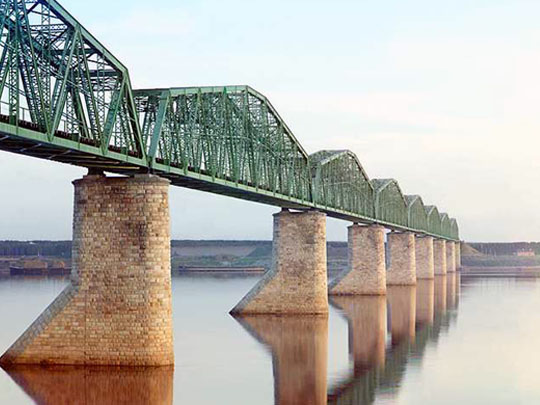
The Trans-Siberian Railway runs 9,289 kilometres from Moscow to Vladivostok across eight time zones, begun in 1891 when the Tsarevich Nicholas turned the first earth at Vladivostok, and built to tie Siberia to the capital and push Russian power into the Far East — though when Japan attacked in 1904 the single track could not move men east fast enough, and the railway meant to secure the region helped lose the war fought over it.
Riding the Trans-Siberian takes about six days end to end, over the Urals, across the West Siberian plain and along the southern shore of Lake Baikal, with the Trans-Mongolian and Trans-Manchurian branches turning south toward Ulaanbaatar and Beijing; the line only ran entirely on Russian soil from 1916, when the Amur section finally closed the gap.
Until August 2018 every timetable, ticket and station clock on the Russian rail network ran on Moscow time whatever the zone outside, so passengers crossed a third of the planet while the platform clocks insisted nothing had changed — you worked out your actual arrival with arithmetic.
18 – Kizhi Pogost
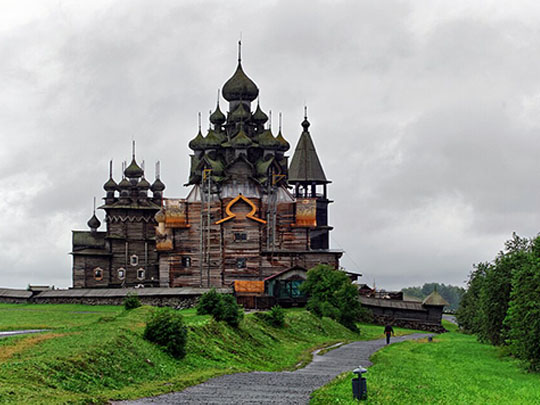
Kizhi Pogost stands on a narrow island in Lake Onega in Karelia, in Russia’s northwest, and is a walled enclosure — which is what a pogost is — holding two wooden churches and a bell tower; UNESCO inscribed it in 1990, and it is the finest survival of a Russian peasant carpentry tradition that has otherwise mostly burned or rotted.
The Church of the Transfiguration of 1714 stacks twenty-two domes in tiers to thirty-seven metres, each one shingled in aspen that silvers as it weathers, with the nine-domed Church of the Intercession of 1764 alongside and a bell tower of 1862 between them; the Transfiguration reopened in 2021 after a decade of restoration that replaced about a third of its timber.
The story is that the Transfiguration went up without a single nail and that its carpenter threw his axe into Lake Onega afterwards, saying there had never been another like it and never would be — the log walls are indeed nailless, interlocked corner on corner, but the roof never was: the shingles alone took some 180,000 nails.