
Wikimedia Commons / CC-BY-SA-3.0 / GFDL
Capital: Riyadh
Population: 35.3 million+
Language: Arabic
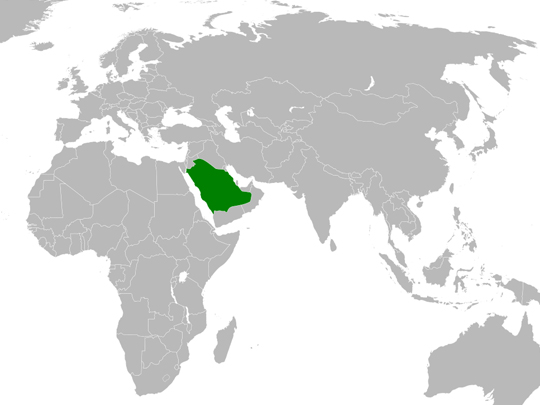
1 – Hegra (Mada’in Salih) (also above)
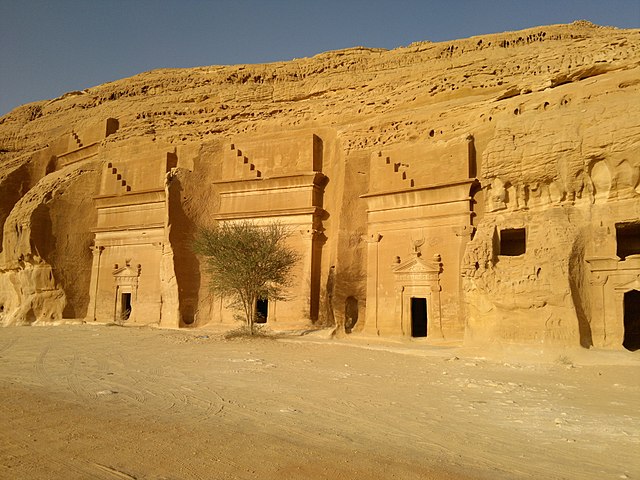
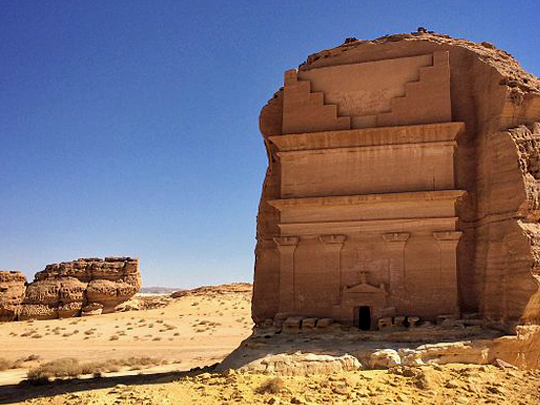
Hegra, long known as Mada’in Salih, lies some 20 kilometres north of AlUla in northwest Saudi Arabia and was the Nabataeans’ southern city — the far end of the kingdom ruled from Petra — and in 2008 it became Saudi Arabia’s first World Heritage Site.
Hegra’s 111 monumental tombs are cut into sandstone outcrops across the plain, 94 of them with carved façades, and the one everyone comes for is Qasr al-Farid, the “Lonely Castle,” four storeys of tomb on its own boulder whose rough, unfinished lower third shows the carvers worked from the top down; visits are by ticketed tour from AlUla, open to ordinary tourists only since 2020.
The name Mada’in Salih — the cities of Salih — ties Hegra to the Quranic story of the Thamud, destroyed for killing the prophet Salih’s she-camel, and that association kept many Saudis away for generations, but there is no archaeological trace of the Thamud here: the tombs are Nabataean, and unusually, many carry dated inscriptions running from 1 BC to around AD 70 — a precision Petra’s own tombs mostly lack.
2 – Al Wahbah Crater
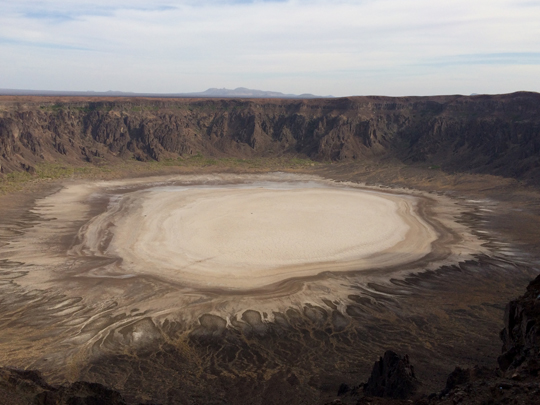
Al Wahbah Crater sits on the edge of the Harrat Kishb lava field northeast of Taif, a hole about 2.2 kilometres across and 250 metres deep, blown out some 1.1 million years ago when rising magma hit groundwater and flashed it to steam — a volcanic maar, not the meteorite crater older guidebooks call it.
The floor of Al Wahbah is a white salt pan, left each time rainwater pools and evaporates, with old date palms partway down the north side; the path from the north rim takes about an hour down, but descents have been restricted, so check before you go and plan on walking or camping on the rim.
Locally Al Wahbah is Maqla’ Tamiyah, “Tamiyah’s quarry,” and the story goes that Tamiyah was a mountain who fell in love with a mountain called Qitn, 300-odd kilometres away, and leapt towards him until a jealous rival speared her in mid-air — the hole she left is the crater, which in 2024 the International Union of Geological Sciences named a top-hundred geological heritage site.
3 – Mount Uhud
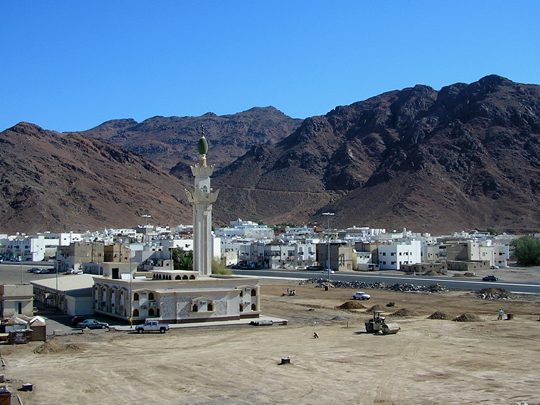
Mount Uhud is a ridge some seven and a half kilometres long on the northern edge of Medina, and in March 625 it was the backdrop to the Battle of Uhud, where around 700 of Muhammad’s followers faced a Meccan army of about 3,000 — the second major battle between the early Muslim community and Mecca, after Badr, and one the Muslims lost.
The battlefield lies at the foot of Mount Uhud: the low mound of Jabal al-Rumah, the Archers’ Hill, faces the mountain, the walled cemetery beside it holds some seventy of the Muslim dead including the Prophet’s uncle Hamza, and the Sayyid al-Shuhada Mosque — “master of the martyrs,” Hamza’s title — is a regular stop for pilgrims to Medina.
The battle turned on fifty archers ordered to hold that hill whatever happened: when the Meccans seemed beaten they came down for the spoils, and the Meccan cavalry rode round into the gap — led by Khalid ibn al-Walid, who within four years had converted and became one of early Islam’s most celebrated generals, the Sword of God.
4 – King Fahd Causeway
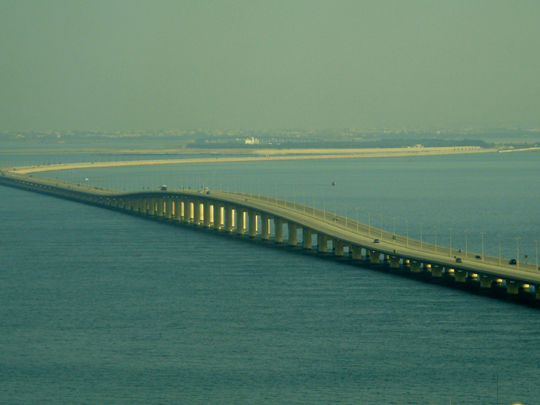
The King Fahd Causeway runs about 25 kilometres across the Gulf from Khobar, in Saudi Arabia’s Eastern Province, to Bahrain, an island that until it opened on 26 November 1986 could be reached from its neighbour only by sea or air — and Saudi Arabia paid for it, somewhere between 800 million and 1.2 billion dollars depending on what you count.
The King Fahd Causeway is five bridges and seven embankments on 536 concrete piers, and halfway across sits Passport Island, an artificial island split between the two countries, with customs and immigration, two mosques, fast food on both sides and twin towers with restaurants at the top.
The King Fahd Causeway took thirty-two years to get from idea to opening — King Saud proposed it in 1954, King Faisal ordered studies in 1965, and the contract went to a Saudi-Dutch consortium in 1981 — and its planned twin, the King Hamad Causeway, with a railway alongside the road, has been moving at much the same pace since it was agreed in 2016.
5 – Jebel Tuwaiq
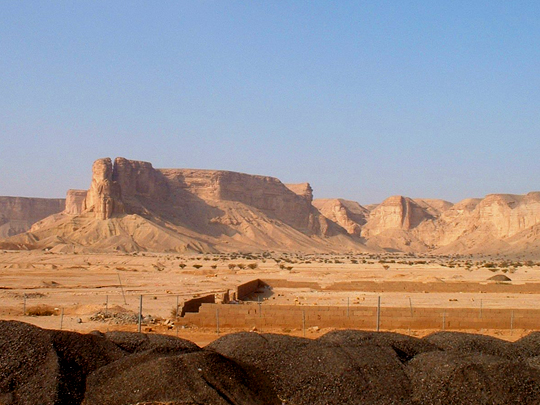
Jebel Tuwaiq is a limestone escarpment running something like 800 kilometres in a long arc through the Najd, the central Arabian heartland — more by some counts — and Riyadh stands on its plateau, with Wadi Hanifa cutting through past Diriyah, the town where the Saudi state began.
The view people drive out for is the Edge of the World, Jebel Fihrayn, about 90 to 100 kilometres northwest of Riyadh, where Jebel Tuwaiq falls away by something like 200 to 300 metres to a plain that runs to the horizon; the last stretch is off-road, so take a high-clearance four-by-four, check which approach is open before you set off, and expect no phone signal.
The cliff top at the Edge of the World was the floor of a shallow tropical sea around 165 million years ago — fossil corals and shells are in the rock under your feet — and the same Jurassic seabed, buried deep further east, holds much of Saudi Arabia’s oil, so what you are standing on is the geology that made the modern kingdom rich.
6 – The Black Stone – Mecca
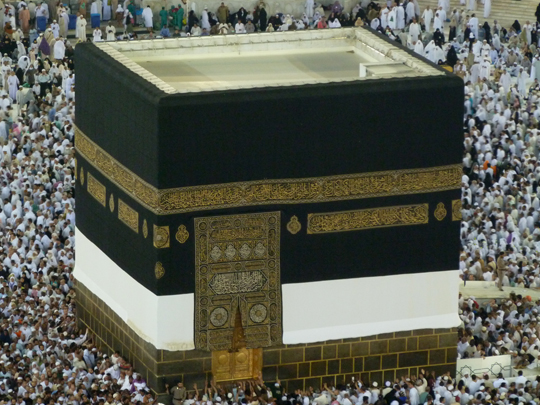
The Black Stone is set into the eastern corner of the Kaaba, the cube-shaped building at the centre of the Grand Mosque in Mecca, and was revered before Islam — tradition holds that in 605, during a rebuilding, Muhammad settled a quarrel among the clans over who should put it back by having it laid on a cloak each clan leader lifted by a corner.
Every pilgrim’s seven circuits of the Kaaba begin and end at the Black Stone, set about 1.1 metres up in a silver frame, its visible face roughly 20 by 16 centimetres, and those who can’t reach it through the crowds raise a hand towards it; Mecca is open only to Muslims.
In January 930 the Qarmatians, an Ismaili movement based in eastern Arabia, sacked Mecca and carried the Black Stone off to Hajar, holding it for twenty-two years; it came back in 952 broken, and a silver frame was first made then to hold the pieces — which is why the stone pilgrims touch is a set of fragments, not a single rock.
7 – At-Turaif, Diriyah
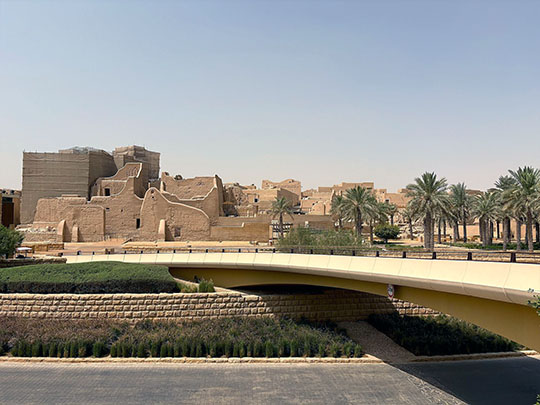

At-Turaif is the walled mud-brick district on a spur above Wadi Hanifa in Diriyah, on the northwest edge of Riyadh, and it was the seat of the Al Saud and capital of the First Saudi State until 1818, when an Ottoman-Egyptian army under Ibrahim Pasha took it after a five-month siege and burned it.
At-Turaif, listed by UNESCO in 2010, is now a restored open-air museum of Najdi adobe — the ruins of Salwa Palace where the first Saudi rulers sat, the Imam Mohammad bin Saud Mosque, a bathhouse and a guest house, with galleries in the old buildings — and the terrace restaurants of Bujairi, across the wadi, look straight back at it.
In 2022 a royal decree created Founding Day, marking 1727, when Muhammad bin Saud took power in Diriyah, rather than the 1744 pact with the preacher Muhammad ibn Abd al-Wahhab that had long been treated as the state’s starting point — so At-Turaif is now officially where the country began, seventeen years earlier than the textbooks used to say.
8 – Historic Jeddah, Al-Balad
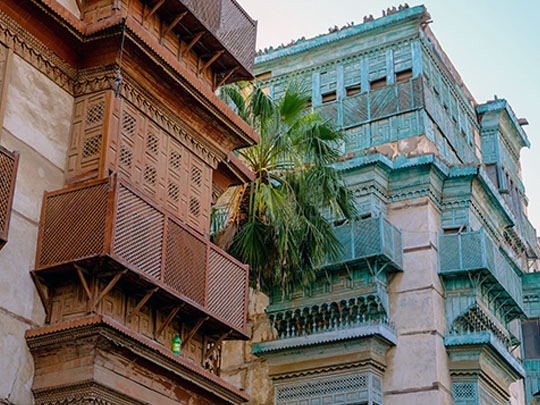

Al-Balad, Historic Jeddah, is the old core of Saudi Arabia’s Red Sea port, made the harbour for Mecca in the seventh century by the caliph Uthman, and for well over a thousand years it was where pilgrims arriving by sea came ashore — hence UNESCO’s 2014 listing as the “Gate to Makkah.”
Al-Balad is built of coral stone cut from the Red Sea reefs, its merchant tower houses hung with rawashin, carved wooden bay windows that let the breeze through while keeping the rooms private, and the one to go inside is Nasseef House, built between 1872 and 1881, with 106 rooms and stairs shallow enough for camels to carry supplies up — Ibn Saud lived there after taking Jeddah in 1925.
Just outside Al-Balad is the cemetery known as the Tomb of Eve, where visitors in the 1920s described a grave some 200 yards long until Prince Faisal had it destroyed in 1928 and religious authorities sealed the site in concrete in 1975 — and a popular reading holds that Jeddah means “grandmother,” after her, though scholars dispute it.
9 – Al-Ahsa Oasis
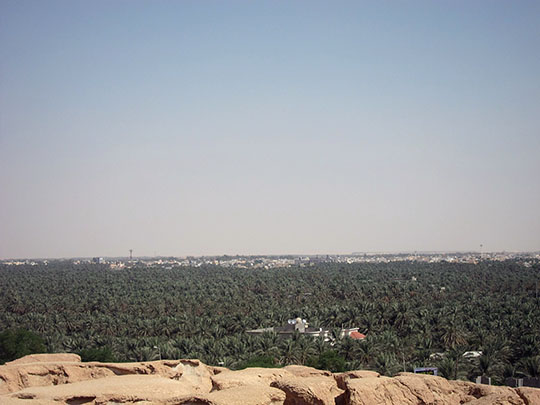
Al-Ahsa is the great oasis inland from the Gulf coast in Saudi Arabia’s Eastern Province, settled since the Neolithic, and from 899 it was the capital of the Qarmatian state — the movement that later carried off the Black Stone from Mecca — with UNESCO listing it in 2018 as a landscape people have farmed without a break for thousands of years.
Al-Ahsa is palm gardens, canals and springs around the town of Hofuf, where the Ottoman fortress of Qasr Ibrahim and the covered Souq al-Qaisariya sit in the old centre, with the wind-carved rock corridors of Jabal al-Qarah close by and the Jawatha Mosque, where tradition places the second Friday prayer ever held in Islam.
In 2020 Guinness registered Al-Ahsa as the world’s largest date-palm oasis — more than 2.5 million palms over some 85 square kilometres, fed by around 280 artesian springs that tap an aquifer under the desert — so the whole landscape, and the city of Hofuf with it, exists because water rises here on its own.