
Wikimedia Commons / CC-BY-SA-3.0 / GFDL
Capital: Singapore
Population: 6.1 million+
Language: Chinese/English/Malay/Tamil
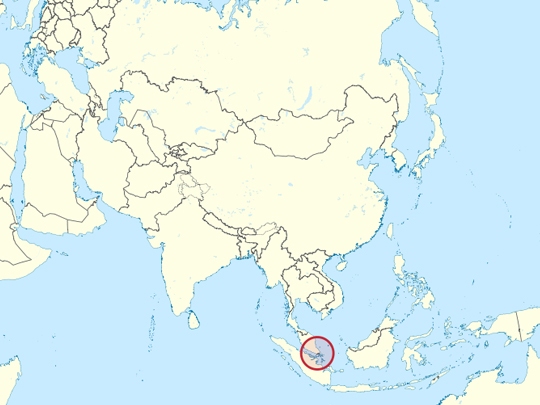
1 – Sentosa (also above)
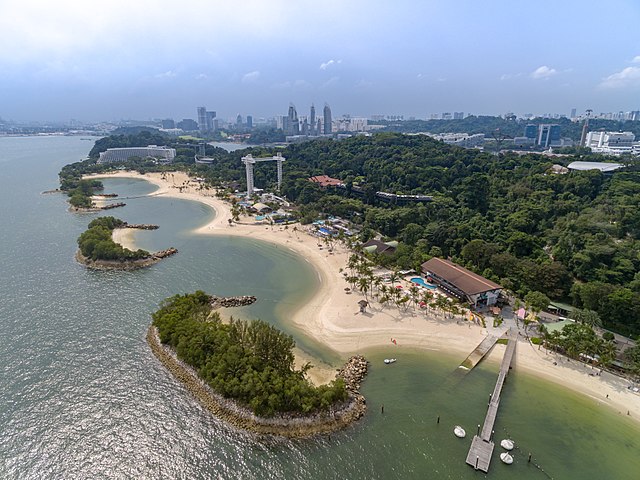
Sentosa is the island off Singapore’s southern shore that the British ringed with coastal guns from the 1870s, and until 1970 it was Pulau Blakang Mati — roughly “behind death,” a name nobody has satisfactorily explained, with piracy, fever and old burials all suggested — before a public contest produced the new name, Malay for peace and tranquillity.
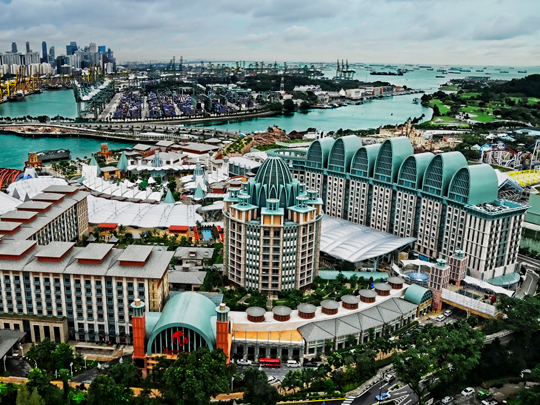
Sentosa today means Resorts World, its casino and Universal Studios Singapore, beaches and a cable car across from Mount Faber, but the history is at Fort Siloso on the western tip: built in 1878, the only complete coastal fort left in Singapore, with tunnels, gun emplacements and the Surrender Chambers, reached by a free eleven-storey skywalk.
The story that Singapore fell in 1942 because its big guns pointed out to sea is a myth — the heaviest guns could swing right round and did fire north, and Fort Siloso itself shelled the Japanese on the west coast — but they carried armour-piercing shells for sinking warships, which do little to infantry, and the invasion came overland through Malaya.
2 – Kusu Island

Kusu Island lies about 5.6 kilometres south of mainland Singapore, a small rocky outcrop reclaimed in 1975 into 8.5 hectares, and its name is Hokkien for tortoise — after the legend of a giant turtle that turned itself into land to save two shipwrecked sailors, one Chinese and one Malay.
Kusu Island has shrines of two faiths a few minutes apart: the Da Bo Gong temple, built by the water in 1923 with money from the businessman Chia Cheng Ho, and up a long flight of steps, the keramat, a Malay shrine of three graves to a holy man, Syed Abdul Rahman, and two women of his family; ferries run from Marina South Pier, and there are no overnight stays.
Every ninth lunar month, roughly October into November, Kusu Island takes in pilgrims — historically over 100,000 a season — praying for health, wealth and children, and the origin story is younger than it sounds: Singapore’s National Library found it changed with each retelling between 1929 and 1973, the holy man’s full name only appearing around 1948.
3 – Night Safari
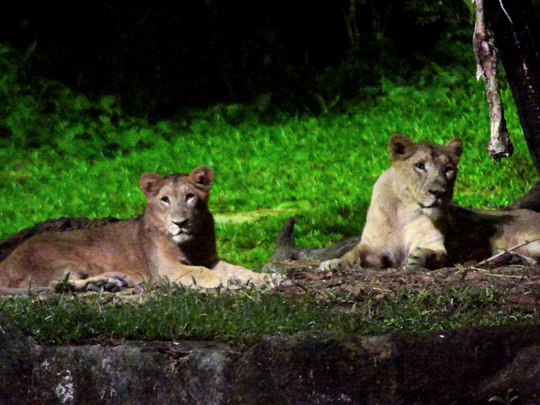
The Night Safari sits on 35 hectares at Mandai in Singapore’s north, next door to Singapore Zoo, and when it opened in May 1994 Guinness recorded it as the world’s first zoo open only at night — an idea from the zoo’s former chairman, Ong Swee Law, that took seven years to build.
At the Night Safari you ride a tram with commentary through the habitats, then walk four trails — Tiger, Pangolin, Leopard and Tasmanian Devil — past roughly a thousand animals from over a hundred species, most of them nocturnal, with the Creatures of the Night show in a 1,000-seat amphitheatre; it opens at 6pm and runs to midnight.
The trick of the Night Safari is the light: a London theatre lighting designer, Simon Corder, lit it to look like moonlight — brighter than the real thing, but dim enough not to disturb the animals — and the gamble paid off at once, with 760,000 visitors in the first year, according to the National Library, against a forecast of 180,000.
4 – Kong Meng San Phor Kark See Temple
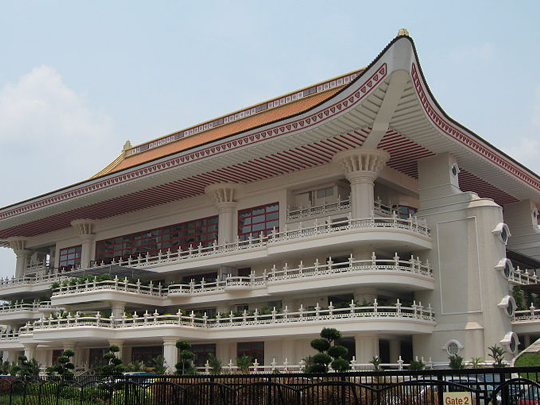
Kong Meng San Phor Kark See Monastery — Bright Hill Monastery in English — stands in Bishan, in the middle of Singapore, and was founded around 1920–21 by the monk Zhuan Dao on donated land; it is usually described as the largest Buddhist monastery in the country.
Much of what you see at Kong Meng San Phor Kark See was built under the abbot Hong Choon, who led it for more than four decades until his death in 1990 — the Hall of No Form with its huge bronze Buddha, a bronze Guan Yin, the Pagoda of 10,000 Buddhas and a memorial hall to Hong Choon himself — and at Vesak the grounds fill with devotees bathing the Buddha.
Bright Hill is also where a great many Singaporeans say goodbye: Kong Meng San Phor Kark See runs one of only two private crematoria in the country, alongside the two government ones at Mandai, and its columbarium holds some 200,000 niches, which makes a monastery few tourists have heard of part of ordinary family life across the island.
5 – Bird Paradise (formerly Jurong Bird Park)
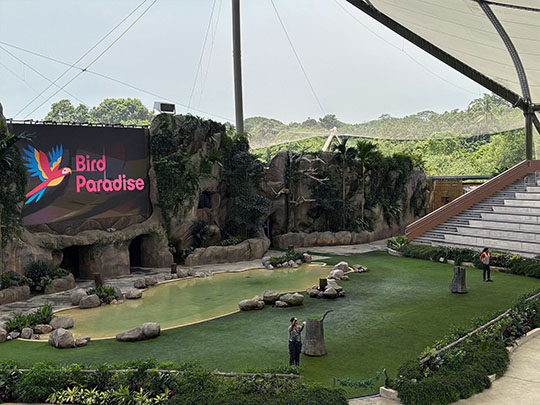
Jurong Bird Park opened in Singapore’s industrial west in January 1971 and closed on 3 January 2023, fifty-two years to the day, after its birds were moved across the island to Bird Paradise at Mandai, beside the Night Safari, which opened that May.
Bird Paradise covers 17 hectares with eight walk-through aviaries, each built around a different part of the world, holding more than 3,500 birds of over 400 species, around a quarter of them threatened — and what Mandai calls the world’s largest collection of hornbills in human care.
The whole idea began with Goh Keng Swee, Singapore’s finance minister, who saw the free-flight aviary at Rio de Janeiro’s zoo in 1968 and came home wanting one, and the original Jurong Bird Park is not quite gone: its Waterfall Aviary, built around a 30-metre man-made waterfall once billed as the world’s tallest, is to be kept as the old site is redeveloped.