

Wikimedia Commons / CC-BY-SA-3.0 / GFDL
Capital: Basseterre
Population: 48,000+
Language: English, Kittitian and Nevisian Creole.
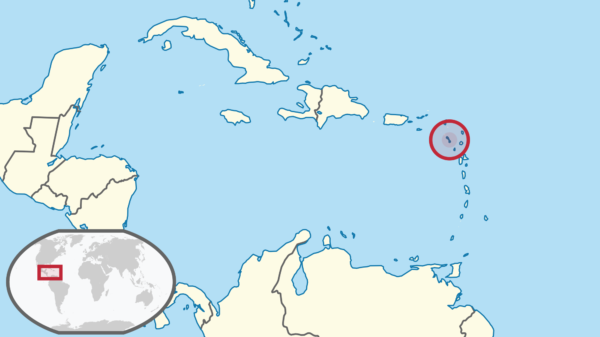
1 – Basseterre
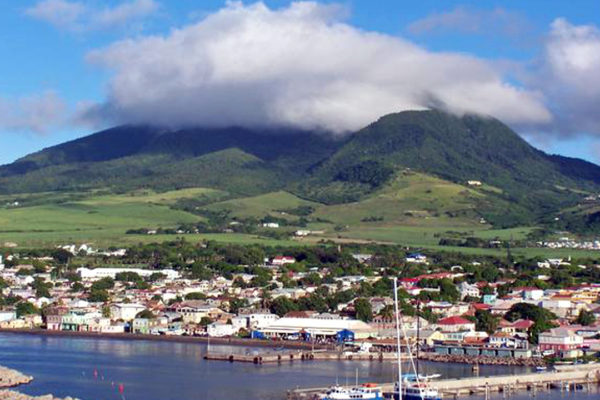
St Kitts’s capital sits on a bay on the south-west coast and still carries its French name, meaning “low land”, from the years when the English and French split this island between them — the first Caribbean island either nation permanently settled, and the springboard for everything that followed.
The centre is the Circus, a small roundabout modelled on Piccadilly and pinned by a green cast-iron clock tower, with St George’s church, the Georgian old Treasury Building and its national museum a few minutes’ walk away.
The green square nearby is called Independence Square now; it was laid out in 1790 as the slave market, and it sits in a town built on the sugar trade that St Kitts effectively invented for the English-speaking Caribbean.
2 – Brimstone Hill Fortress

A fortress covering a steep volcanic hill 230 metres above the western coast, Brimstone Hill was designed by British engineers and built by enslaved Africans over more than a century — a UNESCO World Heritage Site since 1999, and one of the best-preserved forts in the Americas.
Drive up through the bastions to the Fort George citadel at the top, where the cannon look out over the sugar fields, Sandy Point and, on a clear day, four or five other islands.
They called it the Gibraltar of the West Indies, and it fell exactly once: in 1782 a French fleet landed troops who battered it for a month until the garrison surrendered on honourable terms — and the Treaty of Paris handed the island straight back to Britain the following year.
3 – Black Rocks
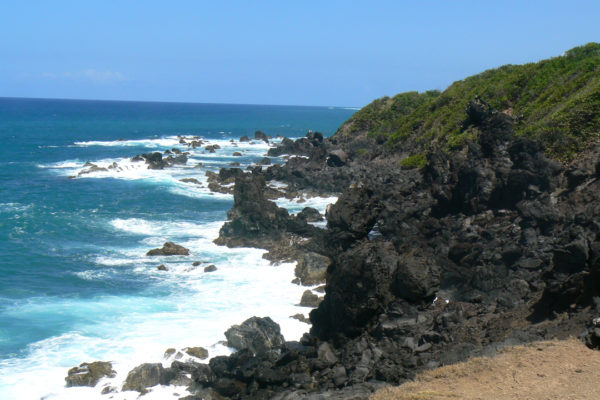
On the rugged Atlantic coast at Belle Vue, north-east of Basseterre, jagged black lava formations run out into the surf — thrown down here by an eruption of Mount Liamuiga, the volcano that made the island.
There’s a viewing area above the cliffs, waves breaking hard below, and the green cone of the mountain behind you.
Liamuiga, “fertile island”, was the Kalinago name for St Kitts, and the volcanic soil it describes is exactly what drew the Europeans — the mountain was called Mount Misery under British rule and given its old name back at independence in 1983.
4 – Nevis
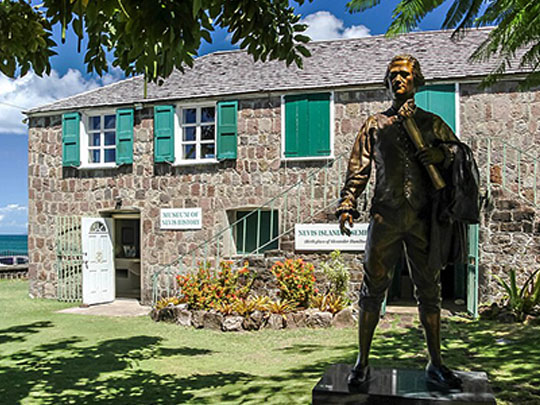
Two miles across a channel from St Kitts, Nevis is a single volcanic cone with a ring of villages around it, and in the 18th century its sugar made it, per head, the richest British colony in the Caribbean.
Charlestown is the one small town — Georgian stone-and-timber buildings, a Jewish cemetery from the island’s Sephardic merchant days, and the hot springs at Bath, where the Bath Hotel of 1778 is generally called the first purpose-built hotel in the Caribbean.
Two men made Nevis famous: Alexander Hamilton was born in Charlestown in the 1750s, in a house now run as a museum, and Horatio Nelson married a young Nevisian widow, Fanny Nisbet, at a plantation house up the hill in 1787.