

Wikimedia Commons / CC-BY-SA-3.0 / GFDL
Capital: Bern
Population: 9.1 million+
Language: German/French/Italian/Romansh

1 – Lauterbrunnen (also above)

Lauterbrunnen lies on the floor of a deep U-shaped glacial valley in the Bernese Oberland, its cliffs rising up to about 1,000 m, and its many falls earn it the tourism nickname “Valley of 72 Waterfalls”.
See Staubbach Falls, nearly 300 m high, ride the tunnel lift to the 10 glacier-fed Trümmelbach Falls inside the mountain, and go up to Mürren and the Schilthorn, whose Piz Gloria restaurant was Blofeld’s lair in On Her Majesty’s Secret Service (1969).
Goethe’s poem “Gesang der Geister über den Wassern” grew out of his 1779 visit to Staubbach Falls in Lauterbrunnen, Byron likened the falls to the tail of the “pale horse” of the Apocalypse in 1816, and in 1911 a young J.R.R. Tolkien walked through the valley on a trek he later said lay behind Bilbo’s journey from Rivendell.
2 – Lucerne


Lucerne sits where the Reuss leaves Lake Lucerne in central Switzerland, and its Kapellbrücke, built around 1360–65 beside the octagonal Water Tower, is Europe’s oldest surviving covered wooden bridge.
Cross the Kapellbrücke, rebuilt after a fire in August 1993 destroyed about two-thirds of its 17th-century paintings, walk the Musegg Wall, and ride up Pilatus on the world’s steepest cogwheel railway, opened in 1889, or the Rigi, Europe’s first mountain rack railway (1871).
The Lion Monument in Lucerne, carved in 1820–21 to Thorvaldsen’s design, honours the Swiss Guards killed at the Tuileries on 10 August 1792 and was called by Mark Twain “the most mournful and moving piece of stone in the world”, and Richard Wagner, living at Tribschen on the lake from 1866 to 1872, had his Siegfried Idyll first played on the villa’s staircase on Christmas morning 1870 as a birthday surprise for his wife Cosima.
3 – Château de Chillon

Château de Chillon stands on a rock island at the eastern end of Lake Geneva near Montreux, first recorded in 1150 and greatly enlarged in the 13th century by the counts of Savoy.
Walk through the courtyards, great halls and chapel, then go down to the vaulted dungeon where the Genevan prior François Bonivard spent the last four years of his imprisonment, until a Bernese army freed him in 1536.
Byron visited Chillon with Shelley on 25 June 1816 and wrote “The Prisoner of Chillon” about Bonivard, and the name “Byron” carved on a dungeon pillar is said to be his, though nobody in his circle ever mentioned it.
4 – Montreux

Montreux stretches along the shore of Lake Geneva on the Vaud Riviera, and the Montreux Convention, signed here in 1936, governs shipping through the Turkish Straits.
See Irena Sedlecká’s 3 m bronze of Freddie Mercury by the lake, unveiled in 1996, the Casino, where Queen owned Mountain Studios from 1978, and the Montreux Palace, home of Vladimir Nabokov from 1961 until his death in 1977.
On 4 December 1971 a flare gun set fire to the Montreux Casino during a Frank Zappa concert, and Deep Purple, in town to record, turned the scene into “Smoke on the Water”, while Rory Gallagher played the Montreux Jazz Festival, founded by Claude Nobs in 1967, many times.
5 – Bellinzona

Bellinzona, capital of Ticino, guards the valley leading to the Gotthard and San Bernardino passes, and its three castles, Castelgrande, Montebello and Sasso Corbaro, were listed by UNESCO with their walls in 2000.
Climb to Castelgrande, a Roman fort in the time of Augustus, walk the Murata wall that once blocked the whole valley, and go up to Sasso Corbaro, the highest of the three castles, begun in 1478.
At the Battle of Arbedo on 30 June 1422 a Milanese army defeated the Swiss outside Bellinzona, but the town joined the Swiss in 1500, and the cantons of Uri, Schwyz and Unterwalden ruled it jointly until 1798.
6 – Grindelwald

Grindelwald lies in a broad valley in the Bernese Oberland beneath the Eiger, and its glaciers drew some of the first Alpine tourists, among them Byron, who in 1816 called the Upper Grindelwald Glacier “like a frozen hurricane”.
Ride up to First for the views, walk towards the Upper Grindelwald Glacier, and look up at the Eiger North Face, first climbed on 24 July 1938 by Heckmair, Vörg, Harrer and Kasparek in a feat the Nazis used for propaganda.
Charles Barrington of Bray, Co. Wicklow, made the first ascent of the Eiger above Grindelwald on 11 August 1858 with the guides Christian Almer and Peter Bohren, and Heinrich Harrer of the 1938 North Face team later wrote Seven Years in Tibet.
7 – St Moritz

St Moritz, high in the Engadine valley of Graubünden, has drawn visitors to its Mauritius spring for millennia, with larch-wood spring housings about 3,400 years old, and is often called the birthplace of Alpine winter tourism.
See the Kulm Hotel, where Switzerland’s first electric light shone in 1878, the Cresta Run, rebuilt from snow every winter since 1884, and the frozen lake and peaks that hosted the Winter Olympics of 1928 and 1948.
In 1864, the story goes, the hotelier Johannes Badrutt bet his British summer guests that they would enjoy a winter in St Moritz, and they stayed until spring, starting the winter season that made the resort famous.
8 – Wengen

Wengen is a car-free village on a terrace about 1,274 m up above the Lauterbrunnen valley, reached only by the Wengernalp Railway, opened in 1893 and billed as the world’s longest continuous rack railway.
Ride the Wengernalp Railway from Wengen on to Kleine Scheidegg, below the Eiger, Mönch and Jungfrau, and walk the alpine paths in summer.
From 1910 the railway ran to Kleine Scheidegg in winter, so mostly British guests could ride up and ski down, and in 1925 British skiers founded the Downhill Only Club in Wengen, while in WWII the village held US airmen interned after their bombers came down in neutral Switzerland.
9 – Bern

Bern, Switzerland’s “federal city” rather than its legal capital, was traditionally founded in 1191 by Berthold V of Zähringen in a loop of the Aare, and its old town was listed by UNESCO in 1983.
Walk about 6 km of arcades to the Zytglogge clock tower, see the Federal Palace and the bears of the BärenPark, and visit Kramgasse 49, where Einstein lived while working on his papers of 1905.
Parliament chose Bern as the seat of federal government on 28 November 1848, though no law makes it the capital, and from 1942 to 1945 the American spymaster Allen Dulles ran his wartime intelligence operation from a flat at Herrengasse 23.
10 – Fribourg

Fribourg, founded in 1157 by Berthold IV of Zähringen on a bend of the Sarine, straddles the line between French- and German-speaking Switzerland.
See the Gothic Cathedral of St Nicholas, built between 1283 and 1490, with its 74 m tower and Józef Mehoffer’s Art Nouveau windows, and the Espace Jean Tinguely – Niki de Saint Phalle in an old tram depot.
The funicular in Fribourg, opened in 1899, is powered by wastewater poured into a tank in the upper car, the last of its kind in Switzerland, and the city’s Grand Pont Suspendu of 1834 held the world record for the longest span until 1849.
11 – Davos

Davos, at 1,560 m in Graubünden, became a health resort in the 1860s when the doctor Alexander Spengler found that tuberculosis patients improved in its winter air, and by 1875 winter guests outnumbered summer ones.
See the Kirchner Museum, devoted to the painter Ernst Ludwig Kirchner, who moved to Davos in 1917, and the old Waldsanatorium where Thomas Mann visited his wife Katia in 1912, the stay behind The Magic Mountain (1924).
Robert Louis Stevenson finished Treasure Island in Davos in the winter of 1881–82, Arthur Conan Doyle skied from Davos to Arosa in 1894, and on 4 February 1936 the student David Frankfurter shot Wilhelm Gustloff, leader of the Nazi party’s Swiss branch, in Davos.
12 – Interlaken

Interlaken, from the Latin “inter lacus”, lies between Lake Thun and Lake Brienz, and grew up around an Augustinian monastery first recorded in 1133 and taken over by Bern at the Reformation.
Ride the rack railway of 1893 up to Schynige Platte for the view over Interlaken and Lake Thun, and walk among the grand hotels that line the town’s central meadow.
The Unspunnen festival, first held near Interlaken in 1805, helped launch the town as a resort, its 83.5 kg throwing stone was stolen by Jura separatists in 1984 and again in 2005, and General Guisan ran the Swiss army from Interlaken from 1940 to 1944.
13 – Geneva

Geneva, at the south-west tip of Lake Geneva, became the “Protestant Rome” under John Calvin, who first arrived in 1536, and joined the Swiss Confederation in 1815.
See the Jet d’Eau, about 140 m high, which began in 1886 as a pressure-release valve, the Palais des Nations, built for the League of Nations, and CERN, where Tim Berners-Lee proposed the World Wide Web in 1989.
The Red Cross was founded in Geneva in 1863 after Henry Dunant witnessed the Battle of Solferino, and from 1940 Seán Lester of Carrickfergus kept the League of Nations going there through WWII as acting Secretary-General, before winding it up in 1946.
14 – Jungfrau

The Jungfrau, at 4,158 m, was first climbed in 1811 and stands at the heart of the Jungfrau-Aletsch area, listed by UNESCO in 2001, beside the Aletsch, the largest glacier in the Alps.
Ride the Jungfrau Railway through the Eiger and Mönch to Jungfraujoch, at 3,454 m Europe’s highest railway station, and visit the Sphinx Observatory, completed in 1937, for the view over the Aletsch Glacier.
The Jungfrau Railway took from 1896 to 1912 to build, twice as long as planned, and opened on 1 August 1912 after its founder Adolf Guyer-Zeller had died, while Byron set scenes of his dramatic poem Manfred (1817) on the Jungfrau.
15 – Zurich

Zurich, on the Limmat where it leaves Lake Zurich, is the largest city in Switzerland, and the Reformation in German-speaking Switzerland began at its Grossmünster when Huldrych Zwingli started preaching there on 1 January 1519.
See the Fraumünster with Marc Chagall’s five windows of 1970, the Cabaret Voltaire, where Dada was born in 1916, and Spiegelgasse, where Lenin lived in 1916–17.
James Joyce wrote much of Ulysses in Zurich between 1915 and 1919, died there on 13 January 1941 and is buried in Fluntern Cemetery, and on 4 March 1945 lost US bombers struck Zurich by mistake, killing five people.
16 – Lake Lugano

Lake Lugano, shared between Switzerland and Italy in southern Ticino, surrounds the Italian enclave of Campione d’Italia, and the city of Lugano sits on its northern shore between Monte San Salvatore and Monte Brè.
Ride the funiculars up Monte San Salvatore, opened in 1890, and Monte Brè, see the Swissminiatur models at Melide, and take a boat to the Swiss Customs Museum across from Gandria, reachable only by water.
Hermann Hesse lived above Lake Lugano at Montagnola, where he wrote much of his later work, won the Nobel Prize in Literature in 1946 and died in 1962.
17 – Locarno

Locarno, on the northern shore of Lake Maggiore, is one of Switzerland’s sunniest towns, and on 16 October 1925 the Locarno Treaties guaranteeing Germany’s western borders were initialled in its town hall.
Go up to the sanctuary of Madonna del Sasso, founded after a friar’s vision in 1480, see the Castello Visconteo, and stand in the Piazza Grande, open-air home of the Locarno Film Festival since 1971.
In March 1945 secret talks at Ascona, just west of Locarno, between Allied generals and the SS led to the surrender of German forces in Italy, and Ascona’s Monte Verità, founded in 1900 as a vegetarian commune, drew Hesse, Klee and Jung.
18 – Verbier

Verbier sits on a south-facing terrace at about 1,500 m in the Val de Bagnes in Valais, looking across to the Grand Combin, and grew from a farming hamlet into one of the best-known Alpine resorts in the second half of the 20th century.
Ride up to Mont Fort, at 3,330 m the highest point above Verbier, for views across the Alps, and stroll the chalet-lined village below.
The Verbier Festival of classical music was founded in 1994 by the Swede Martin Engstroem, who had rented a chalet in Verbier in 1991 and was asked by local officials to create a summer event.
19 – Zermatt

Zermatt lies at the head of the Mattertal in Valais below the Matterhorn, at 4,478 m, and has kept combustion-engine cars out for decades.
Ride the Gornergrat railway, opened in 1898 as Switzerland’s first electric rack railway, to 3,089 m for the classic view of the Matterhorn, and see the rope that broke in 1865 in the Matterhorn Museum.
On 14 July 1865 Edward Whymper’s party made the first ascent of the Matterhorn above Zermatt, but four men died when a rope broke on the way down, and the Carlow-born physicist John Tyndall made the first ascent of the nearby Weisshorn in 1861 and reached the Matterhorn shoulder named Pic Tyndall in 1862.
20 – Laufen Castle and the Rhine Falls

Laufen Castle, first recorded in 858, stands on the Zurich bank of the Rhine Falls, widely billed as the largest waterfall in Europe by volume, 150 m wide and 23 m high, with about 600 m³ of water a second pouring over in summer.
Walk down from Laufen Castle to the Känzeli platform right above the falls, look across to Schloss Wörth on the far bank, and take a boat to the rock in the middle of the Rhine Falls.
J.M.W. Turner painted the Rhine Falls after his first Swiss tour in 1802, and on 1 April 1944 US bombers that mistook nearby Schaffhausen for Ludwigshafen killed about 40 people there.
21 – St Gallen Abbey
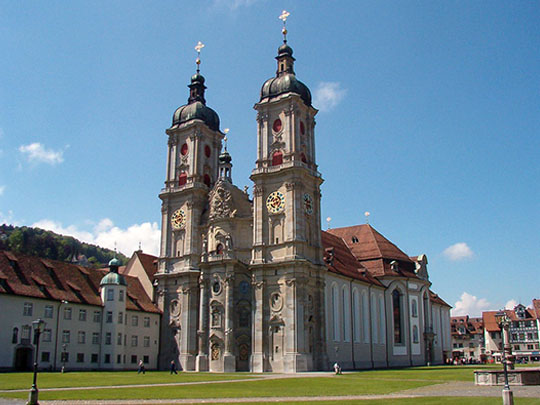
St Gallen Abbey, in north-eastern Switzerland, grew from the cell of the hermit Gallus, traditionally an Irish companion of Columbanus who stayed behind in 612, and became an abbey under Otmar in 719, listed by UNESCO in 1983.
Pull on felt slippers to enter the Baroque Abbey Library of 1758–67, whose door calls it the “healing place of the soul”, with about 170,000 books and 2,100 manuscripts, see the 9th-century Plan of St Gall, and visit the late-Baroque cathedral.
The library of St Gallen Abbey holds a gospel book made by Irish monks around 750 and the St Gall Priscian, written in Ireland around 845–851, in whose margin a monk wrote the Old Irish poem “Is acher in gaíth in-nocht”, glad the stormy night will keep the Vikings away.
22 – Basel
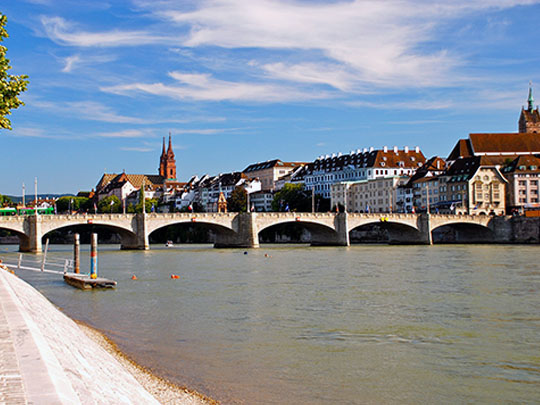

Basel lies on the Rhine where Switzerland meets France and Germany, hosted the Council of Basel from 1431 to 1449, and its university, founded by Pope Pius II in 1460, was the first in Switzerland.
See the red sandstone Minster, consecrated in 1019, with its 12th-century St Gall portal and a memorial to Erasmus, the Kunstmuseum, built on the Amerbach collection the city bought in 1661, and Jean Tinguely’s fountain of 1977.
Erasmus published the first Greek New Testament in Basel in 1516, Theodor Herzl convened the First Zionist Congress here in August 1897 and wrote “At Basel I founded the Jewish State”, and on 19 April 1943 the Sandoz chemist Albert Hofmann rode his bicycle home after the first deliberate dose of LSD.
23 – Lavaux
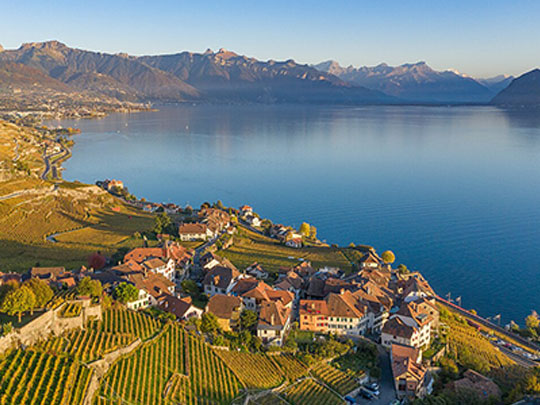

Lavaux’s vineyard terraces run for about 30 km along the north shore of Lake Geneva between Lausanne and Chillon, begun by Benedictine and Cistercian monks in the 11th and 12th centuries, and UNESCO listed almost 900 ha of them in 2007.
Walk the paths or ride the Lavaux Express through villages such as Cully, Epesses, Saint-Saphorin and Chexbres, and taste Chasselas from the two grands crus of Dézaley and Calamin.
Winegrowers in Lavaux credit “three suns”, the sun itself, its reflection off the lake and the heat stored in the stone walls, and in 1977 a campaign led by the environmentalist Franz Weber won a public vote that saved the terraces from development.
24 – Rütli Meadow
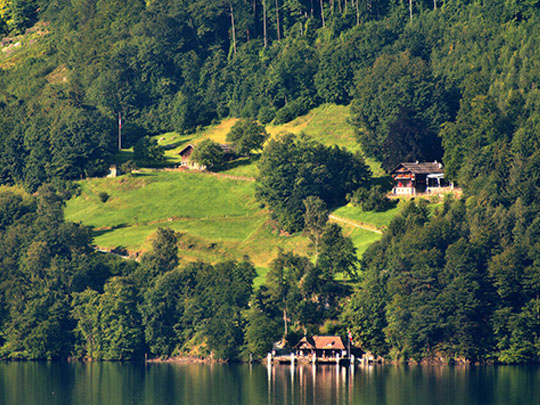
The Rütli meadow, on the shore of Lake Lucerne below Seelisberg in Uri, is where, legend says, men of Uri, Schwyz and Unterwalden swore the oath that founded Switzerland, an event later tied to the Federal Charter of 1291.
Reach the Rütli by boat or on foot from Seelisberg, then follow the Swiss Path, created in 1991 for the 700th anniversary, for about 35 km along the lake to Brunnen.
Swiss schoolchildren raised the money for the Swiss Society for Public Good to buy the Rütli in 1859 and give it to the nation, and on 25 July 1940 General Guisan gathered some 600 senior officers on the meadow to vow that Switzerland would resist any invasion.
25 – Müstair
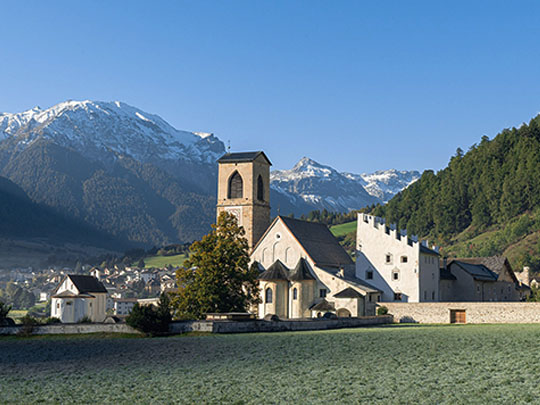

The Benedictine Convent of St John at Müstair, in a remote valley of Graubünden by the Italian border, was founded around 775, probably on the orders of Charlemagne, and UNESCO listed it in 1983.
See the church’s Carolingian frescoes of about 800, the largest surviving cycle of early medieval wall paintings, overlaid in places by Romanesque frescoes of about 1200, and the Planta Tower of about 960, which houses the convent museum.
Legend says Charlemagne founded Müstair after surviving a snowstorm on the Umbrail Pass, the convent holds what is described as the oldest monumental statue of him, and Benedictine nuns have lived here since the 12th century.