

(Ergo) / Wikimedia Commons / CC-BY-SA-3.0 / GFDL
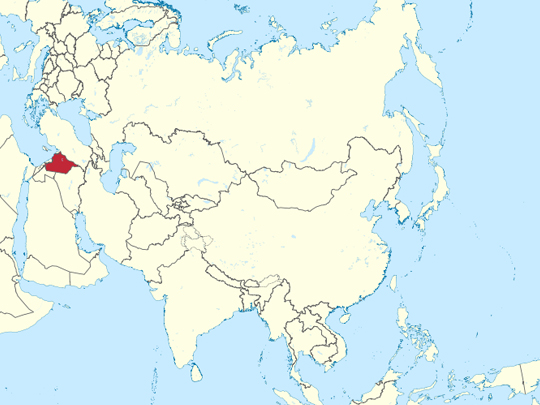
Capital: Damascus
Population: 25 million+
Language: Arabic
1 – Krak des Chevaliers (also above)
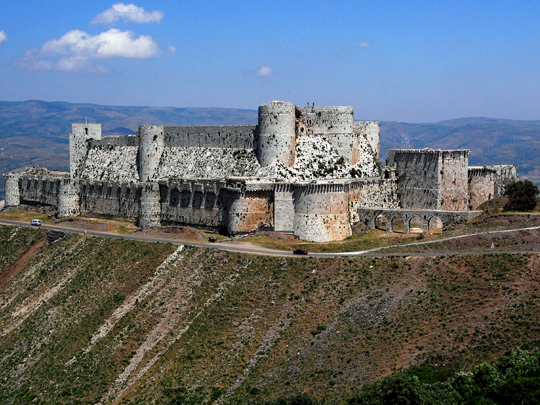
Krak des Chevaliers stands on a hill above the Homs Gap in western Syria, the one easy pass between the coast and the interior, and the Knights Hospitaller held it from the early 1140s until 1271, building a small fort — its Arabic name is still Hisn al-Akrad, the Fortress of the Kurds — into the castle T. E. Lawrence thought perhaps the world’s best preserved.
Krak des Chevaliers is two rings of walls with a reservoir between them, a vaulted ramp and the Hall of the Knights with its Gothic loggia, built for a garrison of up to 2,000 — only about sixty were knights; UN satellite analysts recorded shelling and airstrikes here in 2012–13 that collapsed part of the loggia, and it reopened in 2018 after repairs led by a Syrian-Hungarian team.
Krak des Chevaliers fell in 1271 after a month’s siege by the Mamluk sultan Baybars, and according to Arab chroniclers what ended it wasn’t the tunnel that brought down a tower but a letter, supposedly from the knights’ commander, ordering surrender — forged by Baybars.
2 – Aleppo Citadel
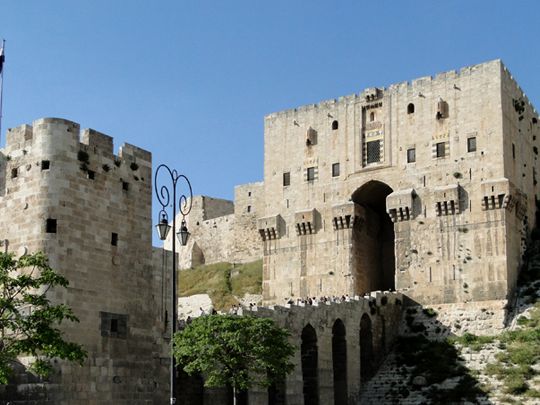
The Citadel of Aleppo crowns a mound in the heart of one of the oldest continuously inhabited cities on earth, occupied since the third millennium BC, and its present shape — the moat, the stone-faced glacis and the bridge up to the gate — is largely the work of Saladin’s son az-Zahir Ghazi around 1200, with the great gatehouse rebuilt by the Mamluks.
Inside the Citadel of Aleppo are a throne hall, mosques, cisterns and barracks, and below it spread the covered souqs, reputedly thirteen kilometres of them; UNESCO and UN satellite analysts found by 2016 that most of the old city’s historic buildings had been damaged, the 11th-century minaret of the Great Mosque fell in April 2013, and the Citadel, hit again by the February 2023 earthquake, reopened in February 2024.
The mound under the Citadel of Aleppo holds a temple of the Storm God that was in use for some 1,500 years from around the 24th century BC — found only in 1996, because the French excavators of the 1920s had stopped digging just short of it.
3 – Palmyra
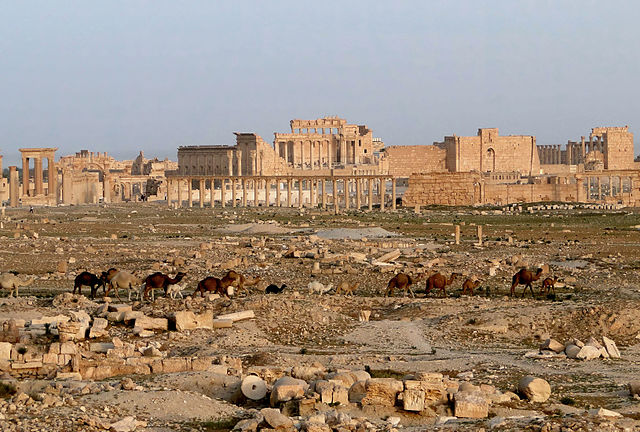
Palmyra, Tadmor in Arabic, is an oasis in the middle of the Syrian desert that grew rich on the caravans between the Mediterranean and the Euphrates, and in the 270s its queen, Zenobia, briefly ruled most of the Roman East, Egypt included, until the emperor Aurelian took the city in 272.
Until 2015 Palmyra’s ruins ran for more than a kilometre — the Temple of Bel, the colonnaded street, the theatre, the Tetrapylon and the tower tombs beyond — and UNESCO and UN satellite analysts recorded the Islamic State group blowing up the Temple of Baalshamin, the Temple of Bel’s sanctuary, tower tombs and the Monumental Arch that year, the Tetrapylon and the theatre’s stage front in 2017, and killing Khaled al-Asaad, who had run the site for forty years.
The Temple of Bel had been in use almost continuously since it was consecrated in AD 32 — a temple, then a church, then from the 12th century a mosque, with a whole village living inside its walls until the French cleared it in the early 20th century.
4 – Bosra
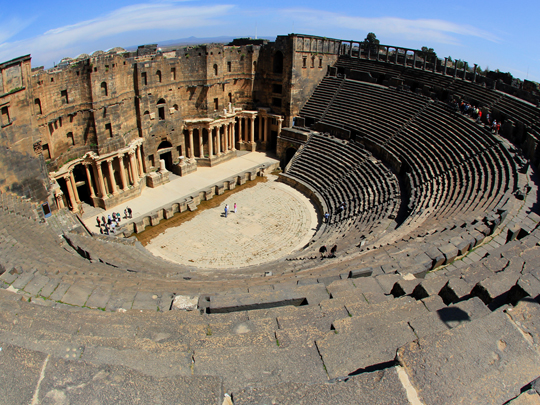
Bosra lies on the black basalt plain of the Hauran in southern Syria, close to the Jordanian border, and rose under the last Nabataean king before becoming the capital of Rome’s province of Arabia after AD 106 — a Roman city on the road to Petra, later a bishopric, and listed by UNESCO in 1980.
The Roman theatre at Bosra, seating perhaps 15,000, is one of the best preserved anywhere, because Arab rulers from the late 11th to the 13th century wrapped a citadel around it and sand filled it; Syria’s antiquities directorate and UNESCO recorded damage to parts of the citadel, the cathedral and the al-Omari Mosque between 2014 and 2015, and a flash flood in April 2018 swamped the stage.
Bosra is where, according to Ibn Ishaq’s life of the Prophet, the boy Muhammad travelling with a trading caravan was recognised by a Christian monk named Bahira — a story most modern historians treat as legend — and a basilica in the old town is still traditionally pointed out as Bahira’s monastery.
5 – Apamea
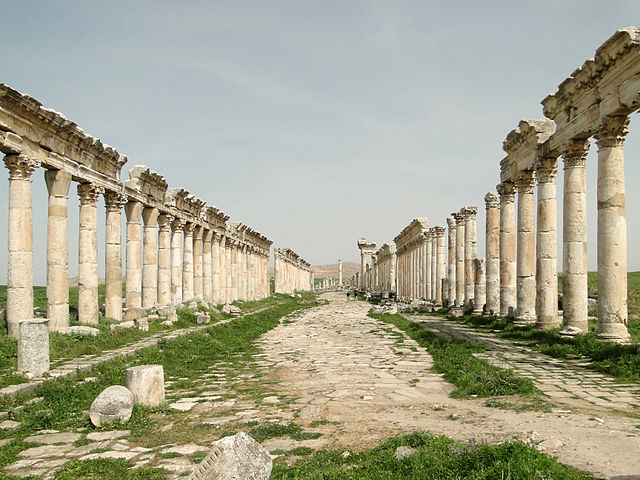
Apamea sits on a plateau above the Ghab valley in north-west Syria, founded around 300 BC by Seleucus I, one of Alexander’s generals, and named after his wife, Apama; it was the Seleucid base for war elephants, and a Roman census stone records 117,000 citizens in its territory around AD 6.
Apamea’s great street, the Cardo, runs for about 1.8 kilometres between rows of columns, some of them spiral-fluted — one of the longest colonnaded streets of the Roman world — and the mosaics went to a museum in an Ottoman caravanserai nearby; Apamea is on Syria’s tentative list for World Heritage, not the list itself.
Apamea suffered less from fighting than from digging: satellite images showed more than 4,000 looting holes across it by early 2014, one study found about 45% of the site looted by October that year, and while the looting had largely stopped by 2016, the mosaics taken with it include one picturing a water wheel like those at Hama.
6 – Dead City of Serjilla
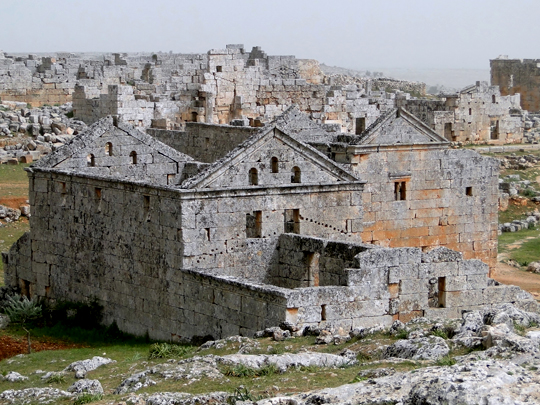
Serjilla is one of the Dead Cities — some forty villages in the limestone hills of north-west Syria, built between the 1st and 7th centuries and listed by UNESCO in 2011 as the Ancient Villages of Northern Syria — and it’s among the best preserved, a Late Antique farming town left standing to the rooflines.
In Serjilla you walk among stone houses, olive presses and sarcophagi, a small church, an inn and a bathhouse whose inscription dates it to 473; the heritage group Syrians for Heritage recorded the ruins being used as a camp by displaced families in 2014–15, then as a military post, and damage from an air strike around 2019–20, and UNESCO said in 2025 that the damage appeared to have worsened.
Serjilla and the other Dead Cities are usually said to have been abandoned when the Arab conquest cut their trade routes, but the archaeologist Georges Tate found a slower story — building stopped around 550, the population outgrew the land, and people drifted back to the plains over the following centuries.
7 – Norias of Hama
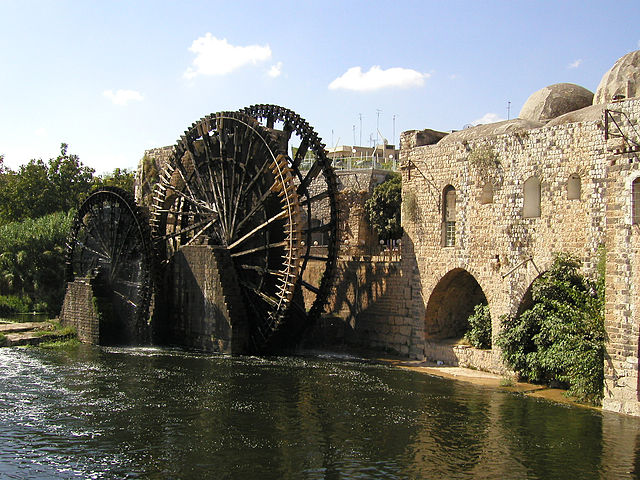
The Norias of Hama are giant wooden water wheels on the Orontes river in central Syria, lifting water into stone aqueducts to irrigate the city’s gardens, and the largest, al-Muhammadiyya, some 21 metres across, is dated by an inscription to 1361; seventeen of them are on Syria’s tentative list for World Heritage.
You hear the Norias of Hama before you see them — the Arabic na’ura comes from a verb meaning to groan — and several still turn when the river is high enough; one wheel was burned in 2014, the number of craftsmen who can build and repair them fell from 35 to nine by 2020, and in the 2025 drought they stopped until water was released from upstream in August.
The oldest known picture of a noria is a Roman mosaic from Apamea, just up the valley — long dated to 469, until a Polish archaeologist identified an older one from the 4th century in 2021, a mosaic that had been stolen by looters ten years earlier.
8 – Umayyad Mosque – Damascus
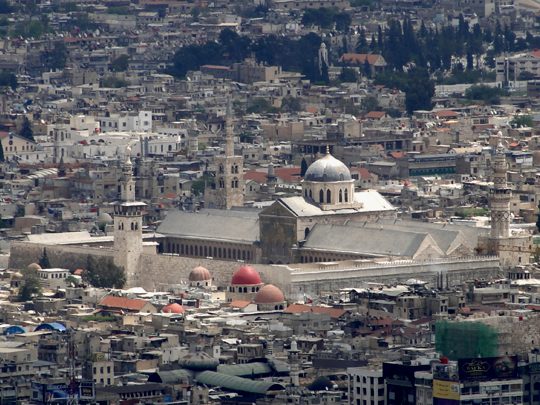
The Umayyad Mosque stands in the old city of Damascus, built between 705 and 715 by the caliph al-Walid I on ground sacred for millennia — an Aramaean temple, the Roman Temple of Jupiter, then the Church of St John the Baptist — and it is one of the oldest and grandest mosques in the world; UNESCO listed old Damascus in 1979.
Inside the Umayyad Mosque’s great courtyard are gold mosaics of rivers, trees and palaces, plastered over for centuries and uncovered from 1928, the shrine said to hold John the Baptist’s head, where John Paul II prayed in 2001 as the first pope to enter a mosque, and the Minaret of Jesus; UNESCO recorded only minor wartime damage nearby.
Saladin is buried in a small tomb in the garden outside the Umayyad Mosque, still in his wooden coffin, beside an empty marble sarcophagus given by Kaiser Wilhelm II in 1898 — and the gilt wreath the Kaiser left was taken by T. E. Lawrence in 1918 and given to London’s Imperial War Museum, which still has it.
9 – Ugarit (Ras Shamra)
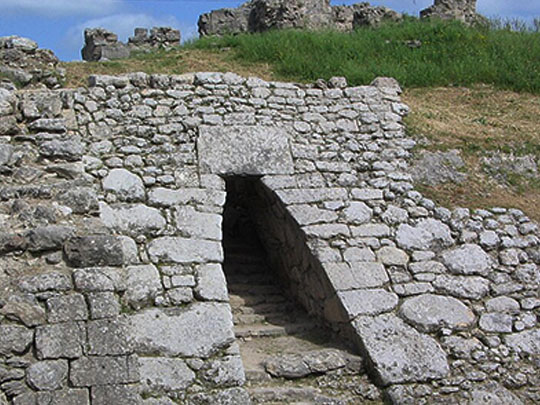
Ugarit is the mound of Ras Shamra on the coast just north of Latakia, a trading kingdom at its height around 1450–1200 BC and destroyed about 1185 BC in the collapse that ended the Bronze Age — and its famous last letter to Cyprus, warning of seven enemy ships and long said to have been found still in the kiln, turned out to have fallen in a basket from an upper floor, the “kiln” a later squatters’ oven.
At Ugarit you walk the royal palace, some ninety rooms whose archives held over a thousand tablets, plus houses and acropolis temples, and the texts found here run to eight languages and scripts — including the Hurrian hymn to Nikkal, the oldest surviving substantially complete notated music, though every modern reconstruction sounds different.
Ugarit’s scribes wrote their language in thirty cuneiform signs, and school tablets list them in order — not the first alphabet, which is older and from Egypt and Sinai, but among the earliest surviving ABCs, in the letter order that runs through Phoenician and Greek to ours.
10 – Dura-Europos
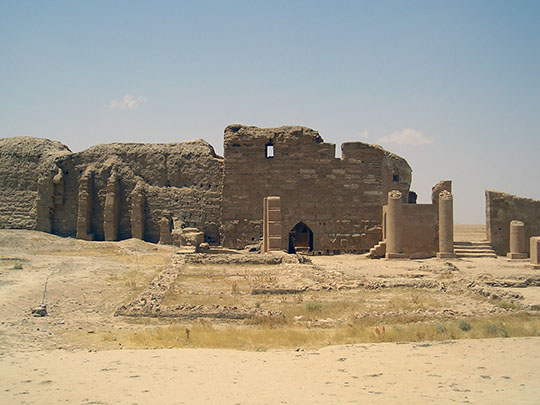
Dura-Europos stands on a cliff above the Euphrates in eastern Syria, founded around 300 BC by one of Seleucus’s generals, then Parthian, and from 165 a Roman frontier fortress, until the Persian king Shapur I took it around 256 and it was abandoned — hence the Pompeii of the desert.
Dura-Europos’s great survivors are in museums: the synagogue of 244, painted floor to ceiling with biblical scenes, rebuilt in Damascus’s National Museum and confirmed intact in 2025, and the earliest securely dated building adapted for Christian worship, now at Yale; on site, a satellite study for AAAS found about 76% of the walled city damaged by looting by April 2014, mostly before the Islamic State group arrived that September.
In a siege tunnel under one of Dura-Europos’s towers lay some twenty Roman soldiers, and the historian Simon James argues the Persians killed them with bitumen and sulphur smoke — the earliest physical trace, albeit circumstantial, of gas warfare; ancient writers describe the trick centuries earlier, but this is where it was found.