
Wikimedia Commons / CC-BY-SA-3.0 / GFDL
Capital: Richmond
Population: 8.8 million+
Language: English

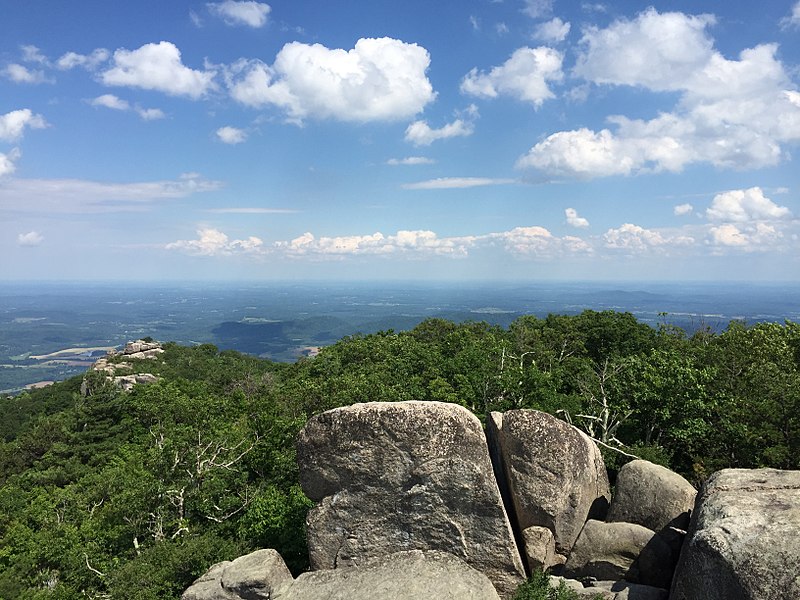
1 – Shenandoah National Park (also above)

Shenandoah National Park runs along the Blue Ridge above the Shenandoah Valley and was established in 1935, but some 465 families, about 2,200 people, were removed to make way for it, their land bought or condemned by the state.
Shenandoah’s Skyline Drive, landscaped largely by the Civilian Conservation Corps, follows the crest for 170 km, the Appalachian Trail runs through the park for about 160 km, Old Rag has the park’s famous rock scramble, and Rapidan Camp, Herbert Hoover’s fishing retreat, is often called the forerunner of Camp David.
Shenandoah’s facilities were segregated until 1950, with Lewis Mountain set aside as the “Negro Area”, while the popular translation of Shenandoah as “daughter of the stars” is a legend, and the folk song “Oh Shenandoah” is probably about the Oneida chief Skenandoa rather than this valley.
2 – Monticello

Monticello, Thomas Jefferson’s hilltop home near Charlottesville, was begun in 1769 to his own design and remodelled until 1809, and it’s a UNESCO World Heritage Site together with his University of Virginia.
Monticello’s west front has long appeared on the US nickel, and much of its fine woodwork was made by Irish joiners James Dinsmore, probably from County Antrim, and John Neilson of Ballycarry, County Antrim, a United Irishman who escaped to America after the 1798 rebellion.
Monticello’s foundation counts more than 600 people enslaved by Jefferson over his lifetime, about 130 of whom were put up for auction in 1827 to pay his debts, and regards it as settled that he fathered at least six children with Sally Hemings, while the epitaph Jefferson wrote for himself leaves out his presidency.
3 – Mount Vernon

Mount Vernon, George Washington’s plantation on the Potomac south of Alexandria, was named by his half-brother Lawrence after Admiral Edward Vernon, under whom he’d served, and it was saved by the Mount Vernon Ladies’ Association, widely described as America’s first national historic preservation organisation.
Mount Vernon’s sights include the mansion, Washington’s tomb and his reconstructed distillery, one of the largest in America when it made nearly 42,000 litres of whiskey in 1799, and among the Irish indentured servants who arrived in 1784 was stonemason Cornelius McDermott Roe, who later worked on the White House and the Capitol.
Mount Vernon’s historians confirm that Washington never wore wooden teeth, as his dentures used human and animal teeth, ivory and metal, and in 1784 he paid enslaved people for nine teeth, while his will provided freedom only for the 123 people he owned of the 317 enslaved at Mount Vernon, leaving the rest in slavery.
4 – Williamsburg

Williamsburg was the capital of colonial Virginia from 1699 to 1780, and its restoration from 1926 was driven by the Rev WAR Goodwin and paid for by John D Rockefeller Jr, who bought property in secret under the telegram code name “David’s Father”.
Colonial Williamsburg’s 120-hectare historic area holds nearly 90 original buildings among hundreds of reconstructions, including Bruton Parish Church, completed in 1715, while the College of William & Mary, chartered in 1693, is often called the second-oldest college in the US.
Williamsburg’s reconstructed Capitol copies the first building of 1705, not the one where Patrick Henry denounced the Stamp Act in 1765, and his famous “If this be treason, make the most of it” was first printed decades later, while the only eyewitness record, a French traveller’s journal, says he apologised.
5 – Arlington National Cemetery

Arlington National Cemetery began on the estate of Mary Custis Lee, wife of Robert E Lee and great-granddaughter of Martha Washington, where in 1864 Union quartermaster general Montgomery Meigs had graves dug around her rose garden to make the house uninhabitable.
Arlington’s sights include Arlington House, the Tomb of the Unknown Soldier, guarded around the clock since 1937, and the grave of President John F Kennedy, while Freedman’s Village housed more than a thousand formerly enslaved people on the estate from 1863 until 1900.
Arlington had been seized illegally, the Supreme Court ruled in 1882, so in 1883 the government bought the estate from Lee’s son for $150,000, and at Kennedy’s funeral in 1963, 26 Irish Army cadets performed a silent drill at the graveside, at Jacqueline Kennedy’s request after he’d admired it in Dublin that June.
6 – Historic Jamestowne


Historic Jamestowne, on the James River, marks where Virginia Company colonists landed in May 1607 to found the first permanent English settlement in the Americas, and in 1619 the first representative assembly in English America met in its church.
Historic Jamestowne’s James Fort was long thought to have washed into the river until archaeologists began uncovering it in 1994, and among their finds are the remains of “Jane”, a teenage girl cannibalised during the Starving Time of 1609–10.
Historic Jamestowne’s best-known story, Pocahontas’s rescue of John Smith, was probably embellished, as he only published it in 1624, and an Irishman, Francis Magnel, who claimed to have spent eight months in Virginia, gave Spain an account of the colony in 1610.
7 – Richmond

Richmond, at the falls of the James River, became Virginia’s capital in 1780 and the capital of the Confederacy in 1861, and Jefferson designed its State Capitol after the Roman temple of the Maison Carrée in Nîmes.
Richmond’s sights include St John’s Church, Hollywood Cemetery, with the graves of Presidents Monroe and Tyler and Jefferson Davis, and Monument Avenue, whose Confederate statues came down in 2020–21, leaving only Arthur Ashe’s, while rafters run Class III–IV rapids through downtown.
Richmond’s St John’s Church heard Patrick Henry’s “Give me liberty, or give me death!” in 1775, but the speech survives only in a version reconstructed by biographer William Wirt in 1817, 42 years later, as no transcript was made.
8 – Virginia Beach

Virginia Beach, the most populous city in Virginia, takes in Cape Henry, where the Jamestown colonists first landed on 26 April 1607, raising a wooden cross three days later, a landing remembered in the name of First Landing State Park.
Virginia Beach’s 5-km boardwalk follows the oceanfront, the Old Cape Henry Lighthouse, lit in 1792, is often called the first federally funded public works project, and Edgar Cayce’s Association for Research and Enlightenment has been based here since 1931.
Virginia Beach is listed by Guinness as the world’s largest pleasure beach, a record often misquoted as the longest, and the colonists’ first night at Cape Henry in 1607 ended in an attack by Native warriors.
9 – Maymont

Maymont, a 40-hectare Gilded Age estate on the James River in Richmond, was built for James and Sallie Dooley, whose mansion was completed in 1893, and was left to the city, opening to the public in 1926.
Maymont’s grounds include an Italian Garden completed in 1910 and a Japanese Garden from 1912, laid out by a Japanese garden master known as Muto, alongside the furnished Dooley mansion.
Maymont’s builder, James Dooley, was the son of Irish immigrants, his father John, a hat-maker, commanded Richmond’s Irish militia company, the Montgomery Guard, and James himself was wounded and captured at Williamsburg fighting for the Confederacy in 1862.
10 – Luray Caverns

Luray Caverns, in the Shenandoah Valley, were found on 13 August 1878 by Andrew Campbell, William “Billy” Campbell and photographer Benton Stebbins, after the party felt cold air rising from a sinkhole, and Smithsonian scientists who visited in 1880 praised the formations.
Luray Caverns’ best-known sight is the Great Stalacpipe Organ, completed in 1957 by Pentagon mathematician Leland Sprinkle, who rigged 37 stalactites to be played from a keyboard.
Luray Caverns’ discoverers bought the land at auction for under $500 without mentioning the cave, but Virginia’s Supreme Court cancelled the sale, and Guinness lists the organ not as the world’s largest instrument but as the largest natural underground one.
11 – Yorktown
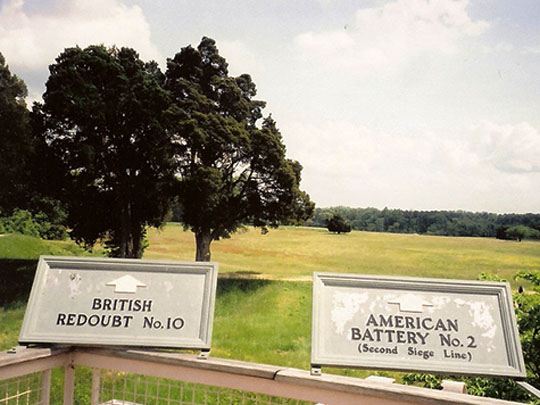
Yorktown, on the York River, is where more than 7,000 British and German troops under Lord Cornwallis surrendered on 19 October 1781 to Washington’s Americans and Rochambeau’s French, after de Grasse’s French fleet had driven off the Royal Navy at the Battle of the Capes and cut off any rescue by sea.
Yorktown’s sights include the battlefield’s siege lines and the site of Redoubt 10, stormed at bayonet point by troops led by Alexander Hamilton, the Moore House, where the surrender terms were drafted, the Nelson House, with cannonballs said to date from the siege, the Victory Monument and the American Revolution Museum at Yorktown.
Yorktown’s British may never have marched out to “The World Turned Upside Down”, a story first printed in 1828, and Cornwallis pleaded illness, so his deputy Charles O’Hara, who later surrendered to Napoleon too, offered his sword to Rochambeau before being steered to Washington’s deputy, Benjamin Lincoln, while Stephen Moylan, a cavalry commander born in County Cork, was among the victors.
12 – Fort Monroe, Old Point Comfort
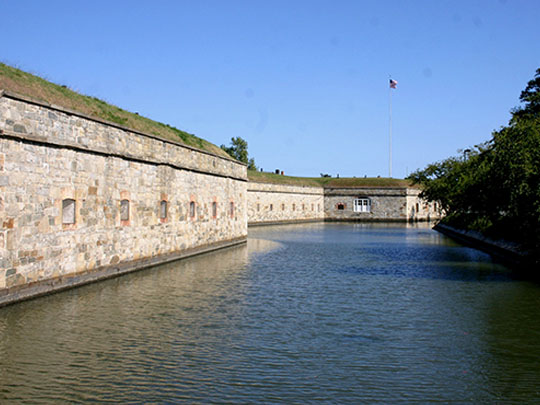
Fort Monroe stands on Old Point Comfort, at the tip of the Virginia Peninsula in Hampton, where in August 1619 the privateer White Lion landed “20 and odd” captive Africans from Ndongo, in modern Angola, the first recorded Africans in Virginia.
Fort Monroe’s sights include the moat-ringed fort, built from 1819 to 1834 and the largest stone fort ever built in the US, the Casemate Museum, with Jefferson Davis’s cell and the story of Edgar Allan Poe, who served here in 1828–29 as “Edgar A Perry”, and the Old Point Comfort Lighthouse of 1802.
Fort Monroe’s commander, Benjamin Butler, refused in May 1861 to return three freedom seekers, Frank Baker, Shepard Mallory and James Townsend, declaring them “contraband of war”, which earned the fort the name “Freedom’s Fortress”, and in 1862 it was the base for McClellan’s Peninsula Campaign.
13 – Appomattox Court House
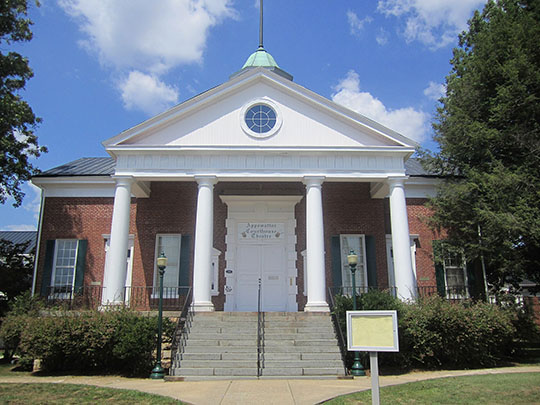

Appomattox Court House, a village in central Virginia, is where Robert E Lee surrendered the Army of Northern Virginia to Ulysses S Grant in Wilmer McLean’s parlour on 9 April 1865, with the final copy of the terms written out by Grant’s military secretary, the Seneca officer Ely Parker.
Appomattox Court House’s sights include the McLean House, dismantled in 1893 for an exhibition that never happened and rebuilt by the Park Service, a job halted by the Second World War, the 1819 Clover Hill Tavern, where Union presses printed about 30,000 parole passes, and the Stage Road, where Confederate infantry stacked their arms on 12 April.
Appomattox Court House drew McLean after the war’s first major battle reached his farm near Manassas, and he’s said to have remarked that the war began in his yard and ended in his parlour, though other Confederate forces surrendered into June, while Thomas Smyth, born in County Cork, died of wounds on surrender day, often called the last Union general killed in the war.
14 – Manassas
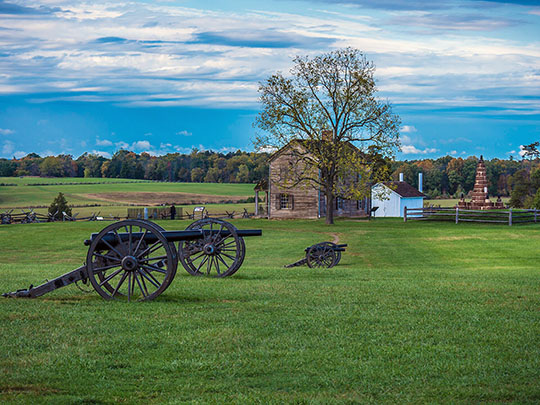

Manassas National Battlefield Park in northern Virginia covers the ground of two Confederate victories, First Manassas on 21 July 1861, the first major battle of the Civil War, and Second Manassas in August 1862, both called Bull Run by the Union, since the North named battles after streams and the South after nearby towns or railway junctions.
Manassas’s sights include Henry Hill, with Joseph Pollia’s 1940 equestrian statue of Stonewall Jackson and the grave of elderly widow Judith Henry, killed when Union guns shelled her house, often called the war’s first civilian casualty, and the Stone House, a field hospital in both battles.
Manassas gave Jackson his nickname, though Gen Barnard Bee’s cry that he stood “like a stone wall” may have been a jibe, the Washington spectators of legend mostly watched from Centreville, about 8 km away, and the Irish 69th New York fought here under Col Michael Corcoran, who was captured, with Thomas Francis Meagher, born in Waterford, leading its Zouave company.
15 – Alexandria
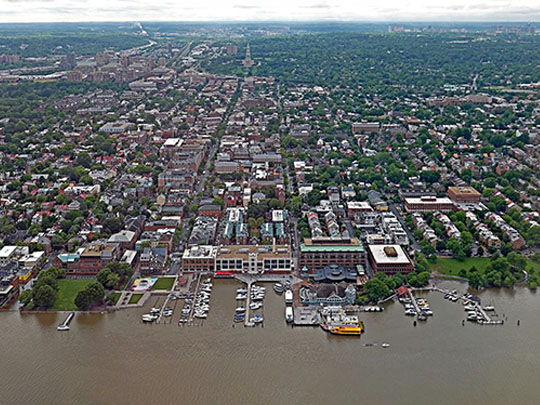

Alexandria, on the Potomac just south of Washington DC, was founded in 1749 and named after the Alexander family, descendants of Scottish settler John Alexander, and it was handed over to the new District of Columbia until its voters chose in 1846 to return to Virginia, partly over fears Congress would ban the slave trade.
Old Town Alexandria’s sights include Christ Church, where you can sit in George Washington’s family pew, Gadsby’s Tavern, which hosted his last two birthday balls, Carlyle House, the Torpedo Factory Art Center in a former navy torpedo plant, and the Freedom House Museum at 1315 Duke Street, the office of Franklin & Armfield, which the city calls the largest domestic slave-trading firm in the US.
Alexandria’s 1971 TC Williams High football team inspired Remember the Titans, and Col John Fitzgerald, an emigrant from County Wicklow who became Washington’s aide-de-camp and later the town’s mayor, hosted a St Patrick’s Day dinner in 1788 to raise money for a Catholic church, with Washington among the donors, leading to St Mary’s, Virginia’s oldest Catholic parish.
16 – Natural Bridge
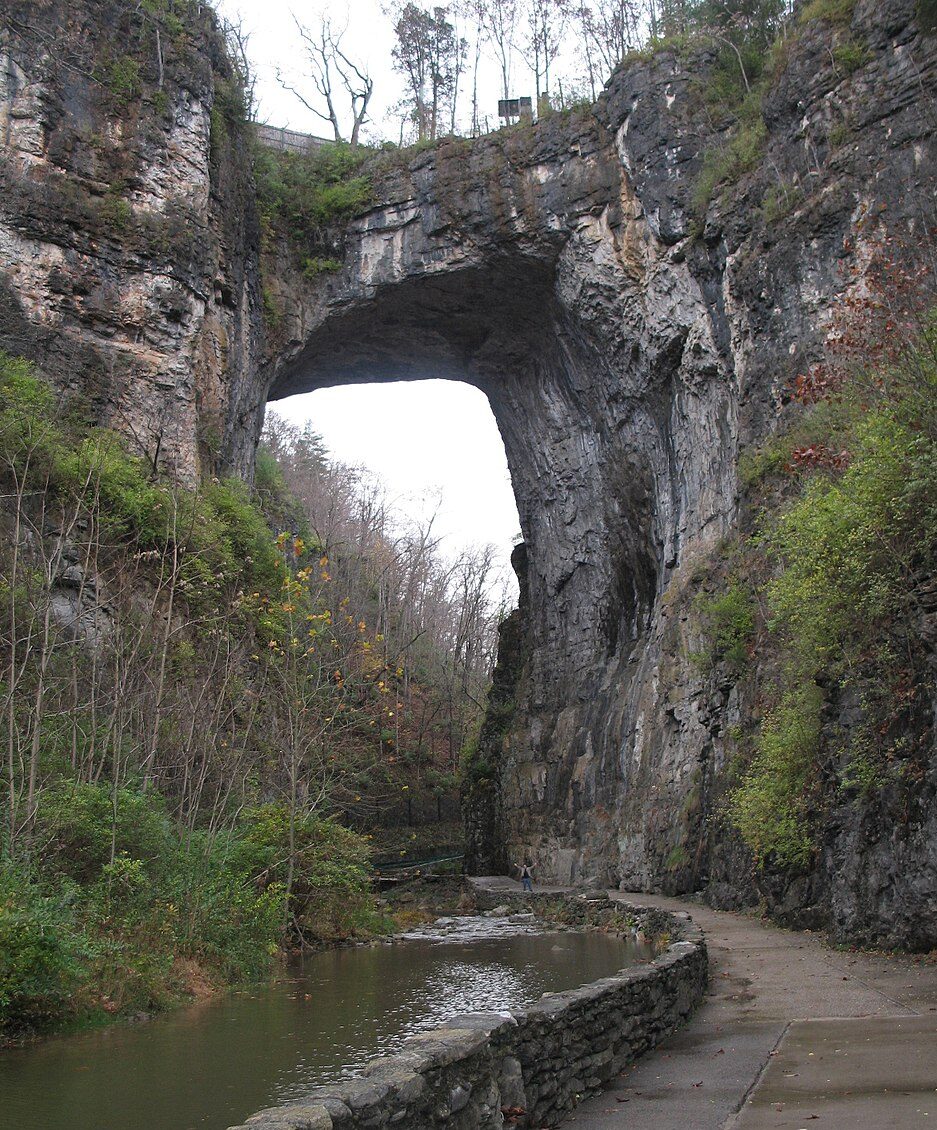
Natural Bridge, in Rockbridge County, which takes its name from it, is a limestone arch about 60 m high carved by Cedar Creek, sacred to the Monacan people, who called it the Bridge of God, and Thomas Jefferson acquired it in 1774 by royal land patent under George III for 20 shillings.
Natural Bridge State Park’s Cedar Creek Trail leads under the arch to Lace Falls, US Route 11 has long run across the top, and Jefferson, who called it “the most sublime of Nature’s works”, built a two-room log cabin here.
Natural Bridge’s carved “GW”, said to be a young George Washington’s initials, is unproven, the old boast that it is one of the Seven Natural Wonders of the World rests on no recognised list, and Frederic Church painted it in 1852 after travelling there with his patron Cyrus Field, who later laid the transatlantic telegraph cable from Valentia Island, County Kerry.