

Wikimedia Commons / CC-BY-SA-3.0 / GFDL
Capital: Charleston
Population: 1.75 million+
Language: English

1 – Elakala Falls (also above)

Elakala Falls is a chain of four waterfalls on Shays Run in Blackwater Falls State Park, near Davis in Tucker County, where the stream tumbles into Blackwater Canyon, and the park was established in 1937.
Elakala Falls’ first drop, about 35 ft, is a short walk from Blackwater Falls Lodge, with a footbridge across its top, while the steep paths down to the lower falls are for experienced hikers only, and the park’s namesake Blackwater Falls plunges 57 ft nearby.
Elakala’s name comes with two competing legends, a princess who leapt after being scorned and a shy warrior who fell fleeing two women, neither provable, and the Blackwater River’s amber colour comes from tannins in fallen hemlock and red spruce needles, not coal.
2 – Harpers Ferry

Harpers Ferry sits where the Potomac meets the Shenandoah, named after Robert Harper, granted the ferry right in 1761, and in October 1859 John Brown raided its US Armory hoping to spark a slave uprising, until Marines under Robert E. Lee’s command stormed the engine house known as John Brown’s Fort.
Harpers Ferry’s sights include Jefferson Rock, where Thomas Jefferson in 1783 called the view “worth a voyage across the Atlantic”, John Brown’s Fort, Storer College, where W.E.B. Du Bois’s Niagara Movement met in 1906, and the Appalachian Trail Conservancy, at the trail’s “psychological midpoint”.
The first man killed by Brown’s raiders at Harpers Ferry was Heyward Shepherd, a free Black railroad worker, the only Marine killed storming the engine house was Irish immigrant Luke Quinn, and St Peter’s, built for Irish canal and railroad labourers, survived the Civil War with its Irish-born priest, Fr Michael Costello, said to have flown the British flag to keep it neutral.
3 – Coopers Rock State Forest

Coopers Rock State Forest, near Morgantown on the Monongalia–Preston county line, is the largest forest in West Virginia’s state forest system, at about 12,700 acres, bought by the state in 1936.
Coopers Rock’s overlook, reached by a footbridge, looks down into the Cheat River Gorge, the Civilian Conservation Corps built the overlook and picnic shelters between 1936 and 1942, and the Henry Clay Iron Furnace, from the 1830s, was the first steam-powered blast furnace in western Virginia.
Coopers Rock takes its name from a legend of a fugitive barrel maker who hid near the overlook and kept making barrels for years, and the CCC built its shelters from American chestnut trees killed by the blight.
4 – New River Gorge Bridge

New River Gorge Bridge near Fayetteville opened on 22 October 1977, a steel arch 3,030 ft long and 876 ft above the river, turning a drive of 40-plus minutes down into the gorge and back out into a crossing of under a minute.
New River Gorge Bridge is the centrepiece of New River Gorge National Park and Preserve, redesignated a national park in 2020, guided tours cross the narrow catwalk beneath its deck, and on Bridge Day each October the deck opens to walkers, BASE jumpers and rappellers.
New River Gorge Bridge was the world’s longest steel arch until China’s Lupu Bridge in 2003, its weathering steel rusts into its own protective coat so it never needs painting, it’s on West Virginia’s state quarter, and the New River, despite its name, may be one of the oldest river systems in the world.
5 – Charleston

Charleston grew from Fort Lee, built in 1788 where the Elk River meets the Kanawha, was chartered in 1794 as Charlestown after founder George Clendenin’s father, and became the permanent state capital in 1885 after the seat had moved back and forth with Wheeling.
Charleston’s sights include Cass Gilbert’s State Capitol, dedicated in 1932, with a gilded dome taller than the US Capitol’s, and the Culture Center on its grounds, home of the public radio show Mountain Stage since 1983, while Daniel Boone lived nearby in the 1790s and represented Kanawha County in the Virginia legislature.
Cork-born labour organiser Mother Jones was court-martialled near Charleston during the 1913 Paint Creek–Cabin Creek coal strike and held for 85 days in a boarding house at Pratt, claiming to be 84 when she was about 75.
6 – Canaan Valley

Canaan Valley in Tucker County, pronounced locally “kuh-NAYN”, is billed as the highest valley of its size east of the Mississippi, with its floor about 3,200 ft up, and its virgin red spruce was logged out between the 1880s and 1920s, with fires burning away its soil.
Canaan Valley’s sights include Canaan Valley Resort State Park, West Virginia’s first ski resort when its slopes opened in 1971, and the Canaan Valley National Wildlife Refuge, the nation’s 500th in 1994, protecting the largest wetland complex in the central and southern Appalachians.
Canaan Valley’s biblical name is said to come from an early settler who looked down and cried “Behold the Land of Canaan”, though a 1746 account said the place could “strike terror”, and its growing season is shorter than that of Fairbanks, Alaska.
7 – Cass Scenic Railroad State Park

Cass Scenic Railroad State Park in Pocahontas County preserves Cass, a company town founded in 1901 by West Virginia Pulp and Paper and named after vice-president Joseph K. Cass, whose mill closed in 1960 before the state took over the logging railroad in 1961.
Cass’s geared Shay steam locomotives haul trains up steep mountain grades to Whittaker Station, a recreated logging camp, and to Bald Knob, at 4,842 ft the third-highest point in West Virginia, and you can stay in the town’s old company houses.
Cass claims the world’s largest fleet of Shay locomotives, including Shay No. 5, built in 1905 and billed as the oldest working Shay, and its first tourist train ran in 1963.
8 – Hawks Nest State Park

Hawks Nest State Park near Ansted in Fayette County, established in 1935, sits on cliffs 585 ft above the New River, named after the ospreys, or “fish hawks”, that once nested on them.
Hawks Nest’s sights include the stone overlook and museum built by the Civilian Conservation Corps in the 1930s and the 1967 lodge designed by Walter Gropius’s firm, The Architects Collaborative.
Below Hawks Nest, a 3-mile tunnel dug in 1930–31 for a Union Carbide company cut through nearly pure silica, and the silicosis that followed killed at least 764 workers by historian Martin Cherniack’s estimate, against 109 admitted by the company, most of them Black migrants from the South, in what’s often called one of the worst industrial disasters in US history, mourned in Muriel Rukeyser’s poem “The Book of the Dead”.
9 – Pricketts Fort

Pricketts Fort State Park, about 5 miles north of Fairmont where Pricketts Creek meets the Monongahela River, marks a log fort built in 1774 during Dunmore’s War and named after Capt. Jacob Prickett, where up to 80 settler families would “fort up” during raids.
Pricketts Fort’s reconstruction, opened for the 1976 Bicentennial, has 12-ft log walls and corner blockhouses staffed by living-history interpreters, alongside the 1859 brick Job Prickett House.
Pricketts Fort was a civilian refuge rather than a military post, and its cemetery holds Zackquill Morgan, founder of Morgantown, and, it’s presumed, John Champe, the Revolutionary War sergeant sent undercover to kidnap the traitor Benedict Arnold.
10 – Seneca Caverns & Rocks

Seneca Rocks in Pendleton County is a fin of Tuscarora quartzite nearly 900 ft high and about 440 million years old, in the Spruce Knob–Seneca Rocks National Recreation Area, created in 1965, while Seneca Caverns near Riverton opened to the public in 1930.
Seneca Rocks’ South Peak can be reached only by technical climbing, so hikers take a trail of about 1.3 miles to an observation deck below the summit, and Seneca Caverns’ tours go 165 ft underground.
In 1943–44 the US Army ran its only low-altitude assault climbing school at Seneca Rocks, training troops for the 10th Mountain Division, the Gendarme rock pillar collapsed on a calm afternoon in 1987, and both the Princess Snow Bird legend and the story of Seneca Caverns’ discovery in 1742 are fiction.
11 – The Greenbrier

The Greenbrier in White Sulphur Springs has drawn visitors to its sulphur spring since 1778, the Chesapeake & Ohio Railway opened the present hotel in 1913, and after Pearl Harbor it held German, Italian and Japanese diplomats before the Army turned it into a hospital.
The Greenbrier’s sights include Dorothy Draper’s colourful post-war interiors, its golf courses, home of the 1979 Ryder Cup, and the once-secret bunker beneath the West Virginia Wing, built from 1958 to 1962 to shelter all of Congress behind a 25-ton blast door.
The Greenbrier’s bunker was never used, and it was built for Congress, not the President as locals assumed, staying secret until the Washington Post exposed it in 1992, while JFK’s parents spent part of their 1914 honeymoon here, and Drogheda’s Des Smyth played in that 1979 Ryder Cup, the first with a European team.
12 – Matewan
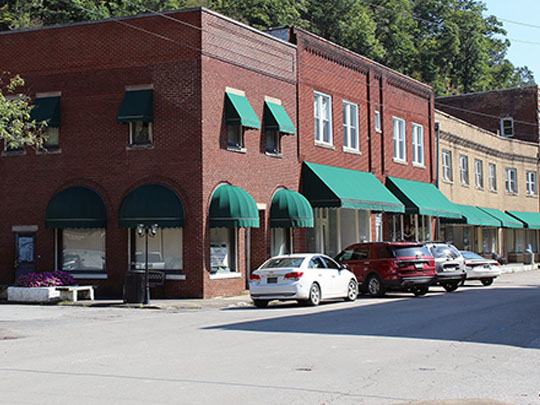
Matewan, on the Tug Fork across from Kentucky, was laid out in 1890 by railway engineer Erskine Hazard and named after his hometown of Matteawan, New York, and on 19 May 1920 police chief Sid Hatfield and Mayor Cabell Testerman confronted Baldwin–Felts detectives evicting union miners’ families, in a shootout that left 10 dead, including the mayor and seven detectives.
Matewan’s sights include the Historic District, where bullet holes scar the buildings, the West Virginia Mine Wars Museum, opened in 2015, and a floodwall whose cast-concrete panels tell the town’s story, and it’s the trailhead for the Hatfield–McCoy off-road trails.
Sid Hatfield’s murder by Baldwin–Felts agents in 1921 helped spark the Battle of Blair Mountain, the Hatfield–McCoy feud didn’t start over a pig, as the 1878 hog trial was just one flashpoint, and John Sayles’s film Matewan was shot in Thurmond, not Matewan, before Sayles went on to make The Secret of Roan Inish in Co. Donegal.
13 – Green Bank Observatory

Green Bank Observatory in Pocahontas County broke ground in 1957 at the heart of the National Radio Quiet Zone, about 13,000 square miles set up in 1958 where radio transmissions are restricted to protect its telescopes.
Green Bank Observatory’s centrepiece is the 485-ft Green Bank Telescope, the largest fully steerable radio telescope in the world, completed in 2000, and the site also holds Grote Reber’s 1937 backyard dish, the first parabolic radio telescope, while petrol engines are banned on the grounds because spark plugs cause interference.
In 1960 Frank Drake ran the first modern search for alien signals at Green Bank, Project Ozma, and in 1961 wrote the Drake Equation for a meeting here, and in 1968 its telescope found the first pulsar inside the Crab Nebula, the supernova remnant named by Lord Rosse at Birr Castle, Co. Offaly.