
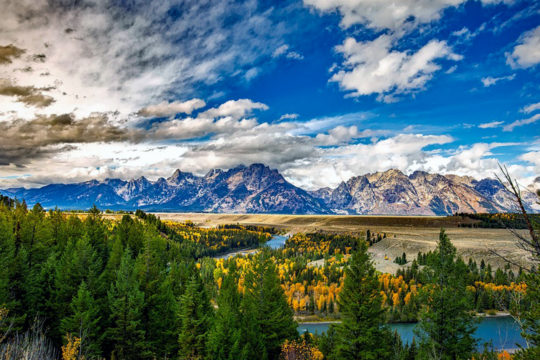
Wikimedia Commons / CC-BY-SA-3.0 / GFDL
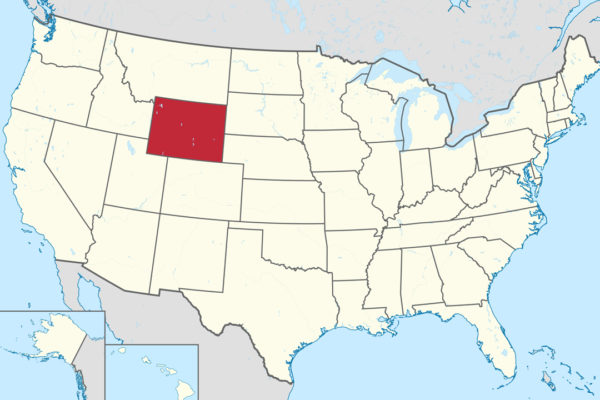
Capital: Cheyenne
Population: 580,000+
Language: English
1 – Grand Teton National Park (also above)
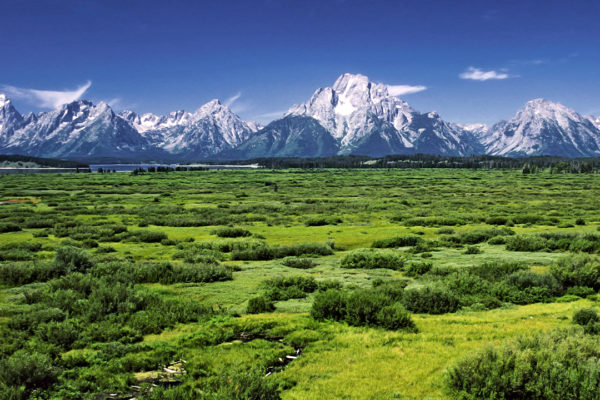
Grand Teton National Park was created in 1929 to protect just the peaks and the lakes at their feet, then merged in 1950 with Jackson Hole National Monument, much of it land John D. Rockefeller Jr. had quietly bought through the Snake River Land Company and given away.
Grand Teton’s sights include the 13,775-ft Grand Teton itself, Jenny Lake, the Mormon Row barns of the Moulton brothers, who homesteaded there from 1908, and the Snake River Overlook, where Ansel Adams took “The Tetons and the Snake River” in 1942, a picture later sent into space on the Voyager Golden Record.
French-speaking trappers named the peaks “les trois tétons”, “the three breasts”, the Teton Range is the youngest in the Rockies though its rocks are more than 2.7 billion years old, and when FDR created the monument in 1943, armed ranchers, including film star Wallace Beery, drove cattle across it in protest.
2 – Yellowstone National Park
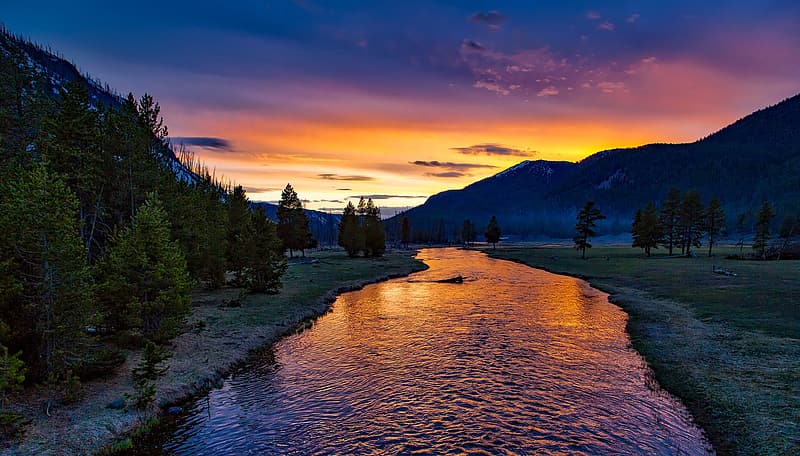
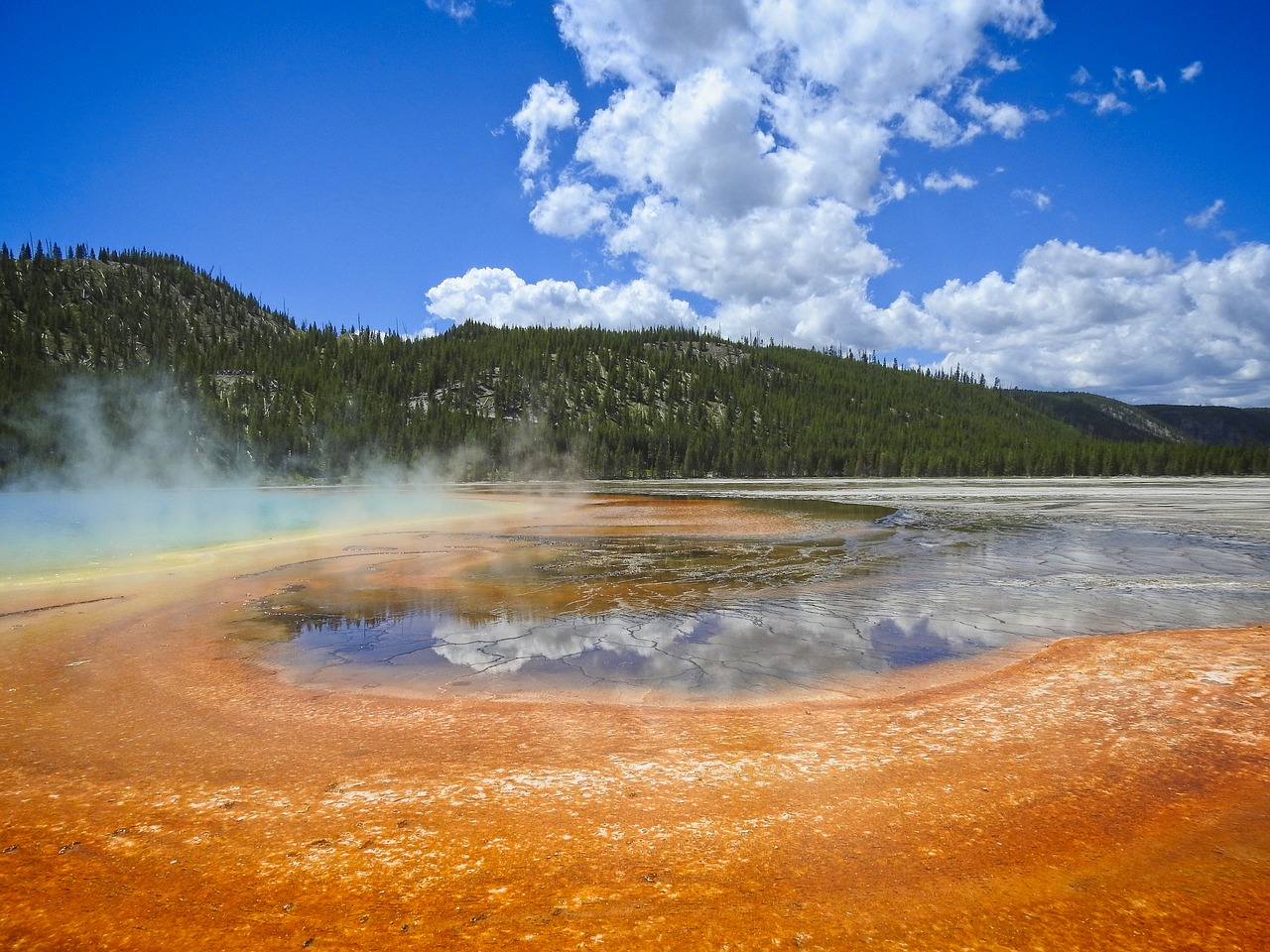
Yellowstone National Park, signed into law by Ulysses S. Grant on 1 March 1872, is generally considered the world’s first national park, and its name comes from the Minnetaree “Mi tse a-da-zi”, “Rock Yellow River”, via French trappers’ Roche Jaune, probably after yellow bluffs far downstream rather than its canyon.
Yellowstone’s sights include more than 10,000 hydrothermal features, with more geysers than anywhere else on Earth, the Grand Canyon of the Yellowstone, the Lamar Valley, where wolves were reintroduced in 1995, and the only bison in the lower 48 to have roamed free since prehistoric times, while Dunraven Pass takes its name from the Limerick-born Earl of Dunraven, who wrote up the park in the 1870s.
Yellowstone’s supervolcano isn’t “overdue”, as the US Geological Survey puts it plainly, Thomas Moran’s paintings and William Henry Jackson’s photographs of 1871 helped persuade Congress to create the park, and Waterford-born Thomas Francis Meagher, acting governor of Montana Territory, was one of the first to suggest a national park here, in 1865.
3 – Jackson Hole

Jackson Hole is the high valley at the foot of the Tetons, “hole” being the trappers’ word for a valley ringed by mountains, named around 1829 after fur trader Davy Jackson, whose grandfather had been transported to America from Coleraine, Co. Londonderry, as an indentured servant.
Jackson Hole’s town of Jackson has a Town Square framed by four arches of shed elk antlers, the first put up in 1953, beside the National Elk Refuge, created in 1912, where Boy Scouts gather antlers for auction, and the ski resort’s “Big Red” aerial tram climbs to 10,450 ft above the plunge of Corbet’s Couloir.
In 1920 Jackson elected an all-female town government, with Rose Crabtree beating her own husband 50 votes to 31, though it wasn’t the first in the US, as Oskaloosa, Kansas, did it in 1888, and Corbet’s Couloir is named after mountaineer Barry Corbet, who looked down it and said “Someday someone will ski that.”
4 – Old Faithful Geyser
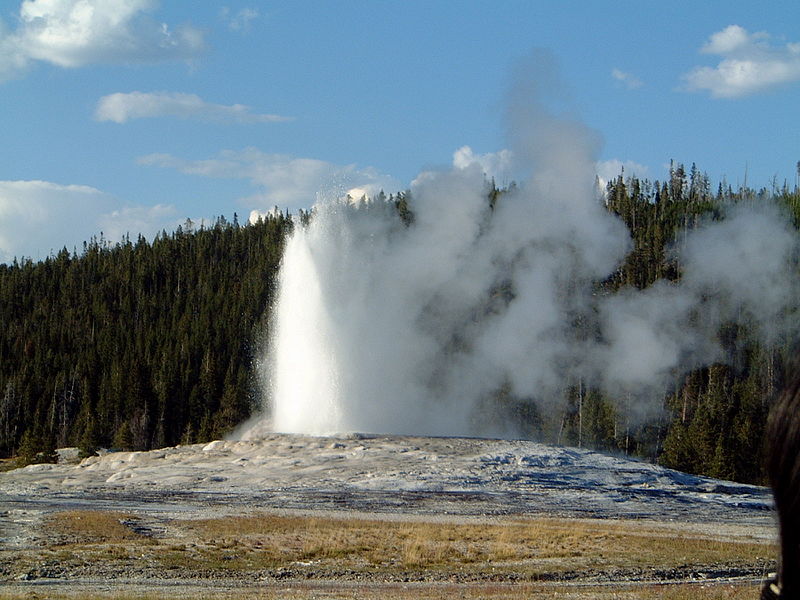
Old Faithful, in Yellowstone’s Upper Geyser Basin, was named by the Washburn Expedition, which reached it on 18 September 1870 and was struck by how regularly it shot water 106 to 185 ft into the air for up to five minutes.
Old Faithful is watched from a boardwalk beside the Old Faithful Inn, opened in 1904 to Robert Reamer’s design, built of lodgepole pine and rhyolite and considered by the Park Service the largest log structure in the world, and rangers predict each eruption from the length of the last.
Old Faithful has never erupted “every hour on the hour”, it isn’t the tallest geyser, as Steamboat can top 300 ft, early visitors used it as a laundry, throwing in clothes to be blasted clean, and petrified trees on its mound show a drought silenced it for decades in the 1200s or 1300s.
5 – Fort Laramie
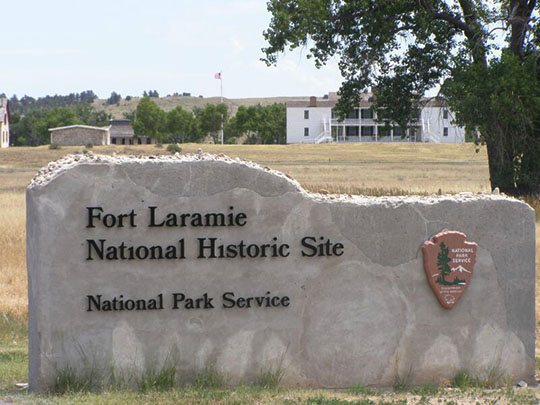
Fort Laramie, where the Laramie River meets the North Platte in Goshen County, began on 31 May 1834 as Fort William, a fur-trading post raised by William Sublette and Robert Campbell’s men, Campbell having been born at Aughalane, Co. Tyrone, in 1804, and the Army bought it in 1849 for $4,000.
Fort Laramie’s sights include Old Bedlam, the 1849 bachelor officers’ quarters named for its rowdy residents and the oldest standing military building in Wyoming, along with restored barracks and officers’ houses on the Oregon Trail, where the fort was also a Pony Express stop in 1860–61.
The 1851 “Fort Laramie” treaty was actually signed at Horse Creek, about 30 miles away, the 1868 Treaty of Fort Laramie promised the Black Hills to the Sioux, and in 1980 the Supreme Court ruled their seizure had to be paid for, money the Sioux refused, while Robert Campbell’s family home was moved to the Ulster American Folk Park near Omagh.
6 – Ames Monument
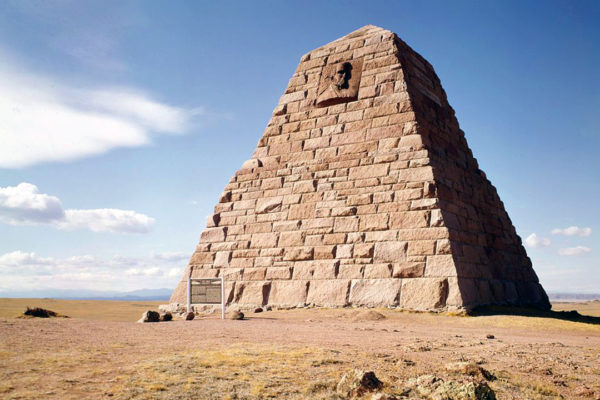
The Ames Monument stands near Buford between Cheyenne and Laramie, a 60-ft granite pyramid designed by H.H. Richardson and built in 1880–82 by the Union Pacific to honour railroad brothers Oakes and Oliver Ames, at Sherman Summit, the highest point of the original transcontinental line.
The Ames Monument’s faces carry 9-ft portrait reliefs of the brothers by Augustus Saint-Gaudens, damaged most likely by rifle fire, and the pyramid was made a National Historic Landmark in 2016.
The railroad was rerouted about 3 miles south in 1901, leaving the Ames Monument alone on the prairie and Sherman a ghost town, Oakes Ames had been censured by Congress in 1873 over the Crédit Mobilier scandal, and a Laramie man, Billy Murphy, once filed a claim to the land and planned to sell advertising on its faces, though he’s not the source of “Murphy’s Law”.
7 – Daisy Geyser
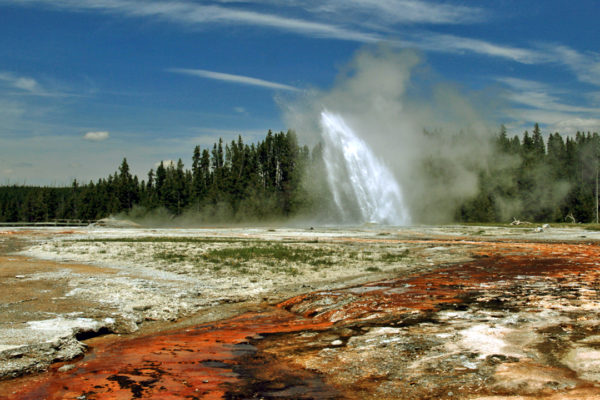
Daisy Geyser, in the Daisy Group of Yellowstone’s Upper Geyser Basin, is a cone geyser that erupts at an angle, up to about 75 ft, for three to five minutes.
Daisy Geyser is one of the five major geysers whose eruptions Park Service naturalists predict, alongside Old Faithful, Castle, Grand and Riverside, and an eruption of its neighbour, Splendid Geyser, can reset its timing.
In 2002 the Denali earthquake in Alaska, almost 2,000 miles away, made Daisy Geyser erupt more often for a few weeks.
8 – Mammoth Hot Springs
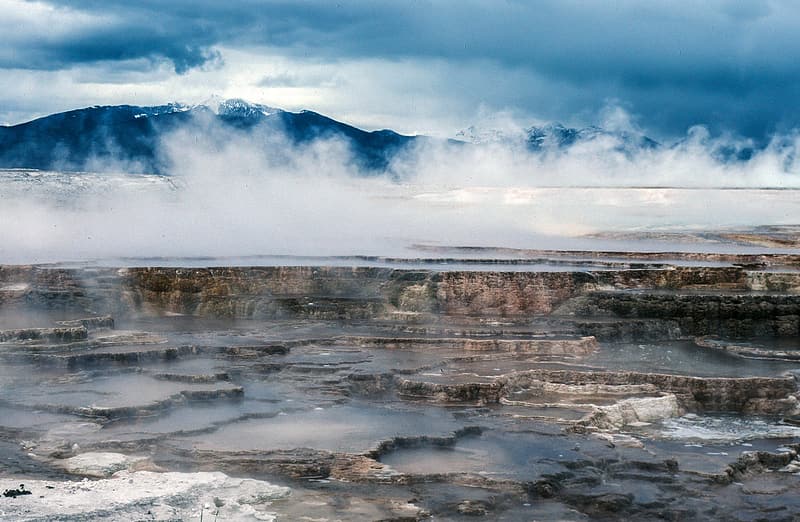
Mammoth Hot Springs, about 5 miles inside Yellowstone’s North Entrance at Gardiner, Montana, but on the Wyoming side of the line, is a hillside of travertine terraces built as hot water dissolves ancient limestone and lays it down again, more than two tons a day.
Mammoth’s sights include Minerva Terrace, named after the Roman goddess, the 37-ft Liberty Cap, and Fort Yellowstone, the Army’s base when it ran the park from 1886 to 1918, whose buildings house the park headquarters and the Albright Visitor Center, while elk graze the old Army lawns.
Mammoth’s colours come from heat-loving microbes, not algae, yellow in the hottest water and orange, brown and green in the cooler runoff, and Liberty Cap, an extinct hot-spring cone, was named by the Hayden Survey in 1871 after the caps of the French Revolution.
9 – Devils Tower
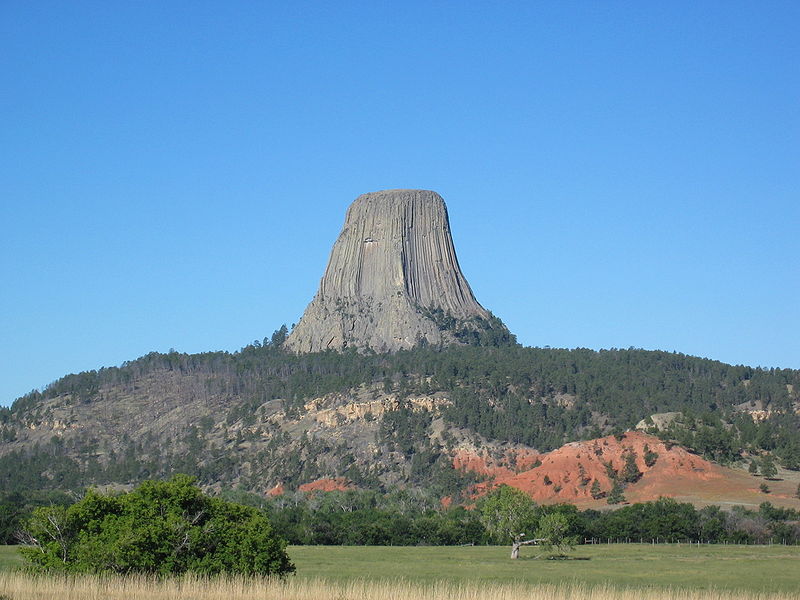
Devils Tower rises 867 ft from its base above the Belle Fourche River in northeast Wyoming, and Theodore Roosevelt made it the first US national monument on 24 September 1906.
Devils Tower’s columns are phonolite porphyry, the Lakota tell of boys saved from a giant bear when the rock rose beneath them, its claws scoring the sides, and on 4 July 1893 ranchers William Rogers and Willard Ripley climbed it on a ladder of wooden pegs before about 1,000 spectators.
Devils Tower’s name may come from an interpreter’s “Bad God’s Tower” on an 1875 Army expedition, though the Park Service says its origin is lost, early maps called it “Bear Lodge”, it has no apostrophe because the US Board on Geographic Names drops them, parachutist George Hopkins was stranded on top for six days in 1941, and it’s the climax of Close Encounters of the Third Kind.
10 – South Pass
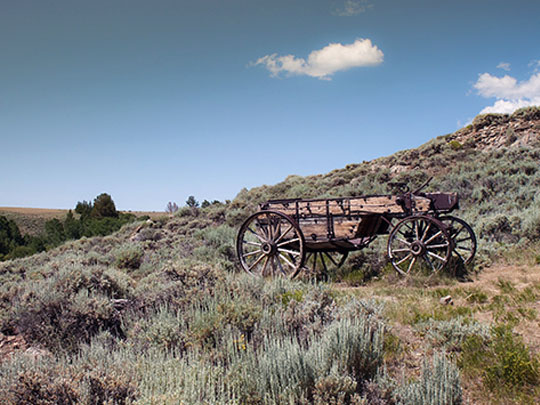

South Pass is a broad saddle about 7,400 ft high across the Continental Divide in Fremont County, first crossed by Robert Stuart’s Astorians heading east in 1812 and rediscovered in 1824 by Jedediah Smith’s party, with Cavan-born Thomas “Broken Hand” Fitzpatrick as second in command.
South Pass carried hundreds of thousands of emigrants on the Oregon, California and Mormon trails, with Fitzpatrick himself guiding the first emigrant wagon company over in 1841, and Narcissa Whitman and Eliza Spalding became the first white women to cross it in 1836, while gold rush South Pass City, founded after an 1867 strike, is a state historic site.
South Pass is so gentle that many emigrants scarcely noticed they’d crossed the Divide, and in South Pass City Esther Morris became the first woman justice of the peace in the US in 1870, though the story that she inspired Wyoming’s 1869 women’s suffrage law first appeared about 50 years later.
11 – Independence Rock
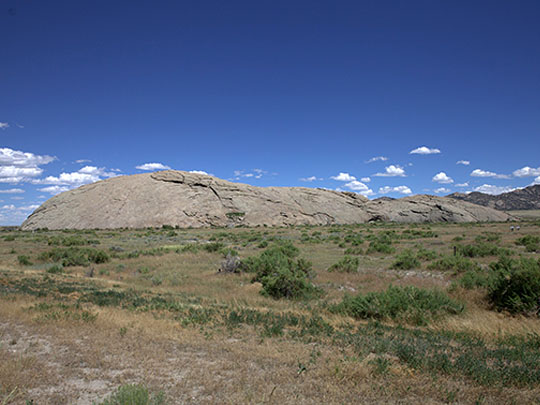

Independence Rock is a granite whaleback around 130 ft high beside the Sweetwater River in Natrona County, one of the great landmarks of the Oregon Trail, named for a Fourth of July celebration, with the best evidence pointing to William Sublette’s party in 1830.
Independence Rock is covered in thousands of names that emigrants carved or painted in axle grease and tar, many of them faded or lost to lichen, earning it Fr Pierre-Jean De Smet’s nickname “the Register of the Desert”, and nearby are Devil’s Gate, a river gorge about 330 ft deep, and Martin’s Cove.
Emigrants hoped to reach Independence Rock by 4 July, but the idea that they had to is legend, as they arrived all season, and at nearby Martin’s Cove more than 100 Mormon handcart pioneers died after snow trapped their company in November 1856.
12 – Heart Mountain
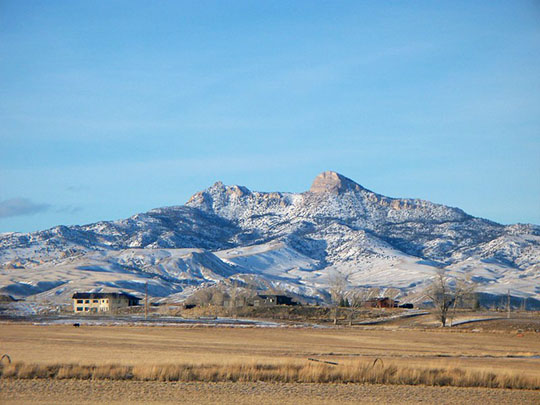
Heart Mountain, between Cody and Powell, gave its name to a War Relocation Authority camp where Japanese Americans were held from August 1942 to November 1945, with 10,767 people at its peak, briefly making it the third-largest town in Wyoming.
Heart Mountain’s Interpretive Center, opened in 2011, tells the story of the camp, where 63 young men who refused the draft while their families were held behind barbed wire were convicted in 1944 in Wyoming’s largest mass trial, before Harry Truman pardoned them in 1947.
Inside the Heart Mountain camp, Boy Scout Norman Mineta met a Cody Scout, Alan Simpson, and both went on to Congress and helped pass the 1988 Civil Liberties Act, which apologised to incarcerated Japanese Americans, while the mountain itself is a block of ancient limestone carried onto much younger rock about 50 million years ago by the largest known landslide on land.
13 – Cody
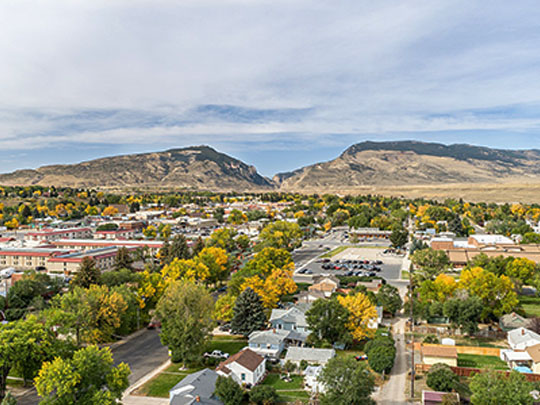

Cody, in the Bighorn Basin of northwest Wyoming, was founded in 1896 by investors including William F. “Buffalo Bill” Cody, the scout and showman whose Wild West show toured Britain and Europe.
Cody’s sights include the Buffalo Bill Center of the West, with five museums from Plains Indian culture to Western art and firearms, the Irma Hotel, opened in 1902 and named after his daughter, the Cody Stampede rodeo, held since 1920, Old Trail Town’s relocated frontier buildings, and the Buffalo Bill Dam, the world’s tallest when it was finished in 1910.
The Irma’s cherrywood bar wasn’t a gift from Queen Victoria, who was dead before the hotel opened, Buffalo Bill is buried not in Cody but on Lookout Mountain in Colorado, and in 1948 Cody’s American Legion offered $10,000 to anyone who’d steal his body back, and despite the family’s long-told story, his ancestors came from the Channel Islands, not Ireland.