
Wikimedia Commons / CC-BY-SA-3.0 / GFDL
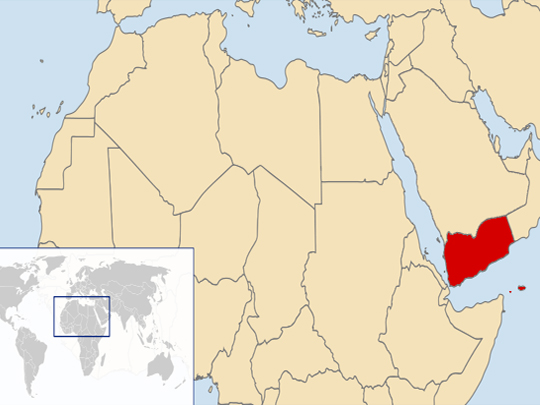
Capital: Sana’a
Population: 41 million+
Language: Arabic
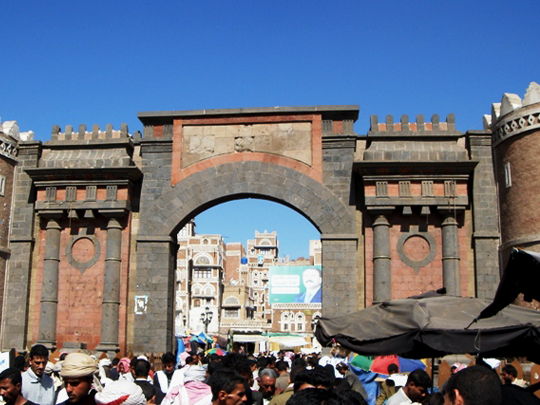
1 – Gate of Yemen (above)
Bab al-Yemen, the Gate of Yemen, is the southern gate of the walled old city of Sana’a, the gate the road south to Taiz and Aden has left by for centuries, and it is usually called more than a thousand years old — which is true of the site, but not of the gate.
Through Bab al-Yemen you step into Suq al-Milh, the Salt Market, the labyrinth of stalls selling spices, silver, raisins, qat and the curved jambiya daggers men wear at the belt, with the tower houses of the old city rising behind it.
The Gate of Yemen you see is far younger than its legend — one German geographer dated its present form to the 17th century, and it has been rebuilt and renovated since — and it’s one of the few gates left, because after the 1962 revolution much of Sana’a’s old wall and several of its gates were pulled down for new roads.
2 – Cisterns of Tawila
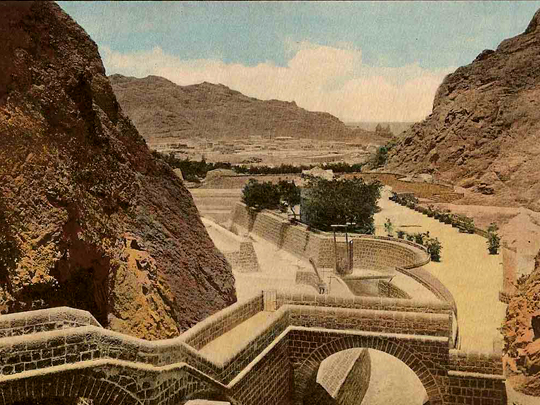
The Cisterns of Tawila are a chain of stone water tanks cut into a ravine below the rim of the volcanic crater that holds the old town of Aden, built to catch the rare rains that rush down off the mountain — and nobody knows who first built them, though they’re mentioned by the 10th-century geographer al-Hamdani.
The Tawila cisterns step down the gorge in curving, plastered basins, a dozen or more of an original fifty or so, together able to hold something like 19 million gallons, with a small garden at the bottom — the tanks are dry most of the time, because Aden gets so little rain.
The Tawila cisterns were buried under debris when a British officer, Robert Playfair, set about clearing them in the 1850s, and his engineers rebuilt them as fewer, larger tanks — which first filled in October 1857 and haven’t filled for well over a decade; the popular story that the Queen of Sheba built them has nothing behind it.
3 – Rock Palace
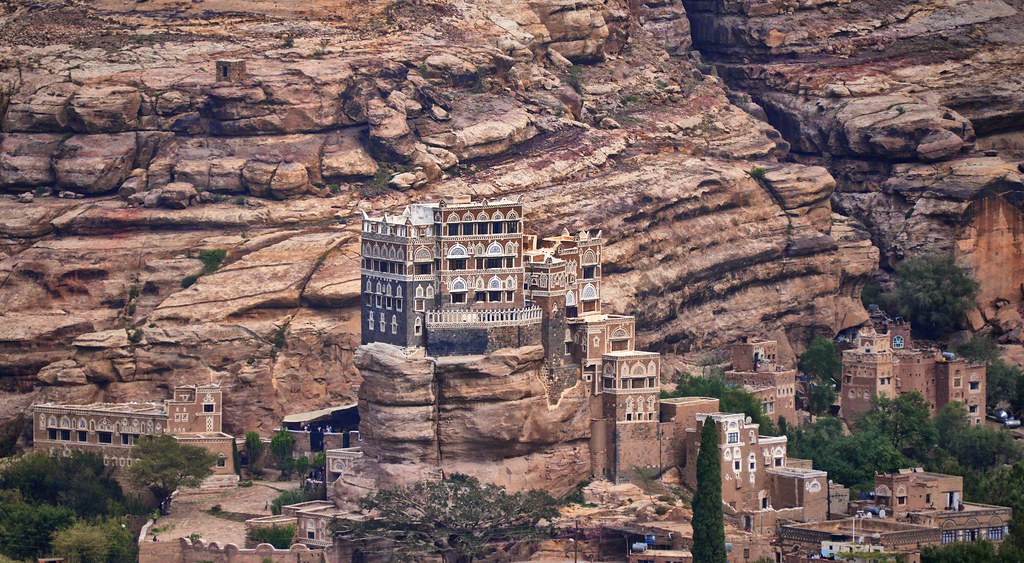
Dar al-Hajar, the Rock Palace, stands on a pinnacle of rock in Wadi Dhahr, about fourteen kilometres north-west of Sana’a, on what Yemen says was the site of a pre-Islamic fortress; it was built in 1786 by Imam al-Mansur Ali and remade in the 1920s by Imam Yahya as his summer residence.
Dar al-Hajar rises five to seven storeys — the lowest of them cut into the rock itself — in Yemen’s traditional style, with stone below, mud-brick and white gypsum decoration above, and a well dug some seventy metres down through the rock; it is now a museum.
Dar al-Hajar is probably the most recognisable building in Yemen — it appears on the 500-rial banknote and in Pasolini’s film Arabian Nights — and Yemen put it on UNESCO’s tentative list for World Heritage in June 2025.
4 – Socotra Island
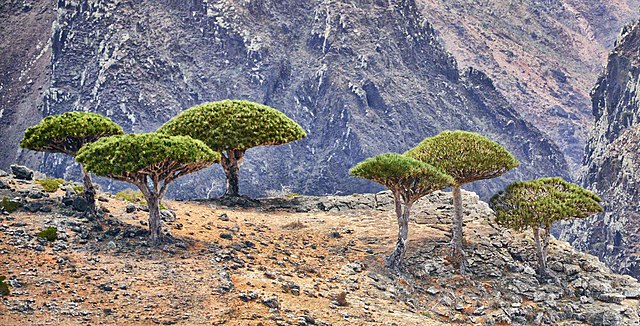
Socotra lies in the Arabian Sea about 380 kilometres south of Arabia and 230 kilometres off the Horn of Africa, an island cut off from the mainland for millions of years, and UNESCO listed it in 2008 for a natural world found nowhere else — 37% of its plant species, 90% of its reptiles and 95% of its land snails are unique to it.
Socotra is known for its dragon’s blood trees, shaped like umbrellas turned inside out, and its swollen bottle trees, with white beaches, limestone plateaus and caves — a fragile place, where two cyclones in November 2015 uprooted many of them.
Deep in Socotra’s Hoq Cave, Belgian cavers found nearly 250 inscriptions and drawings left between the 1st century BC and the 6th century AD by sailors from India, South Arabia, Ethiopia, Greece, Palmyra and Bactria — and the island’s red resin, traded round the ancient world for dyes and medicine, is still sold as “dragon’s blood.”
5 – Sana’a
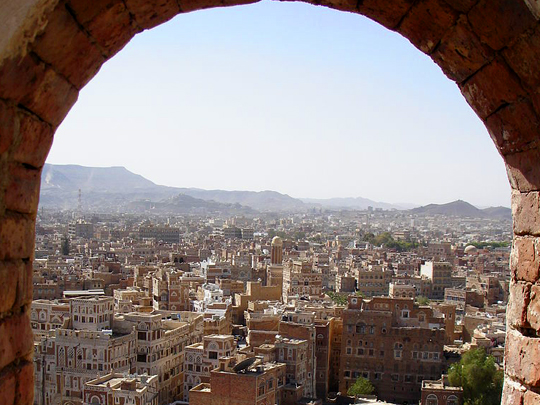
The old city of Sana’a, high on a plateau at about 2,300 metres, has been lived in for more than 2,500 years, and UNESCO, listing it in 1986, counted 103 mosques, 14 bathhouses and more than 6,000 houses built before the 11th century; it has been on the List of World Heritage in Danger since 2015.
Sana’a’s tower houses rise five and six storeys in brown stone and brick picked out in white gypsum, with stained-glass windows, around walled gardens, and at the centre is the Great Mosque, traditionally founded in the Prophet’s lifetime and enlarged in the early 8th century.
In 1972, workers repairing the roof of Sana’a’s Great Mosque found a hoard of old manuscripts, and among them was a palimpsest whose hidden lower text is one of the oldest known Qurans, its parchment dated to between 578 and 669 — while in June 2015 UNESCO reported tower houses in the old city’s al-Qasimi quarter destroyed, and in August 2020 floods damaged around a thousand of its houses.
6 – Aden
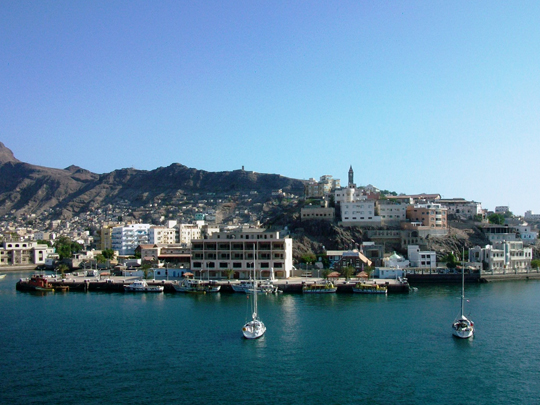
Aden sits on a peninsula on Yemen’s south coast at the mouth of the Red Sea, its old town, still called Crater, built inside the broken cone of an extinct volcano, and from 1839 to 1967 it was a British possession, a coaling station on the route to India.
Aden’s sights are mostly British-era — the clock tower nicknamed Little Ben, colonial-era churches and offices — around a deep natural harbour that was among the busiest refuelling ports in the world in the 1950s.
The French poet Arthur Rimbaud came to Aden in 1880, having given up poetry for good, and worked as foreman in a coffee warehouse for seven francs a day — he called the town “a dreadful rock,” and kept coming back to it until 1891.
7 – Al-Hajjarah
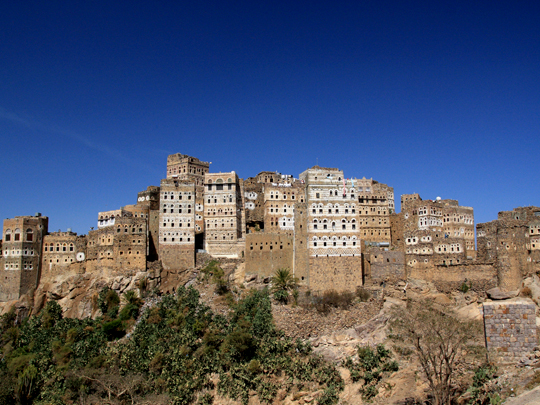
Al-Hajjarah is a fortified village of stone tower houses on a ridge in the Haraz mountains west of Sana’a, near Manakha, said to date from the 12th century, when the region was a stronghold of the Sulayhid dynasty, and parts of the Haraz are Ismaili to this day.
Al-Hajjarah’s houses rise five and six storeys straight from the rock edge, built so close together that the outer walls form the village’s defences, and around it the mountains are terraced from valley floor to summit for coffee and qat — some of the most spectacular terraced landscape in Arabia.
A short way from al-Hajjarah, the tomb of a 12th-century Ismaili missionary, Hatim ibn Ibrahim, at al-Hutayb draws Dawoodi Bohra pilgrims from India, Sri Lanka and beyond — and the Haraz has been on Yemen’s tentative list for World Heritage since 2002.